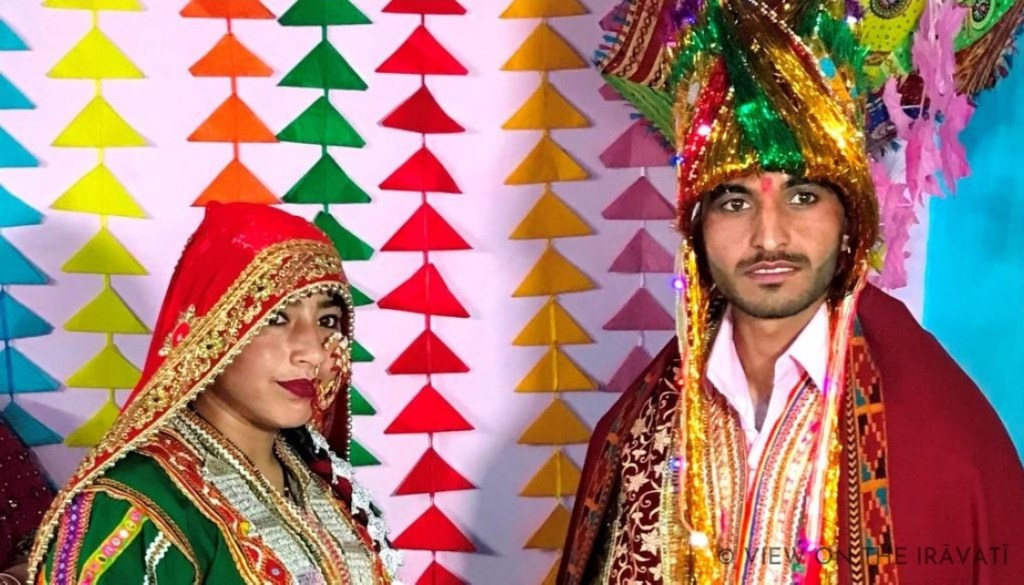
Try to keep up over four days of dancing, eating, talking, and endless chai drinking at a marriage in a Gaddī village.
You’re Invited
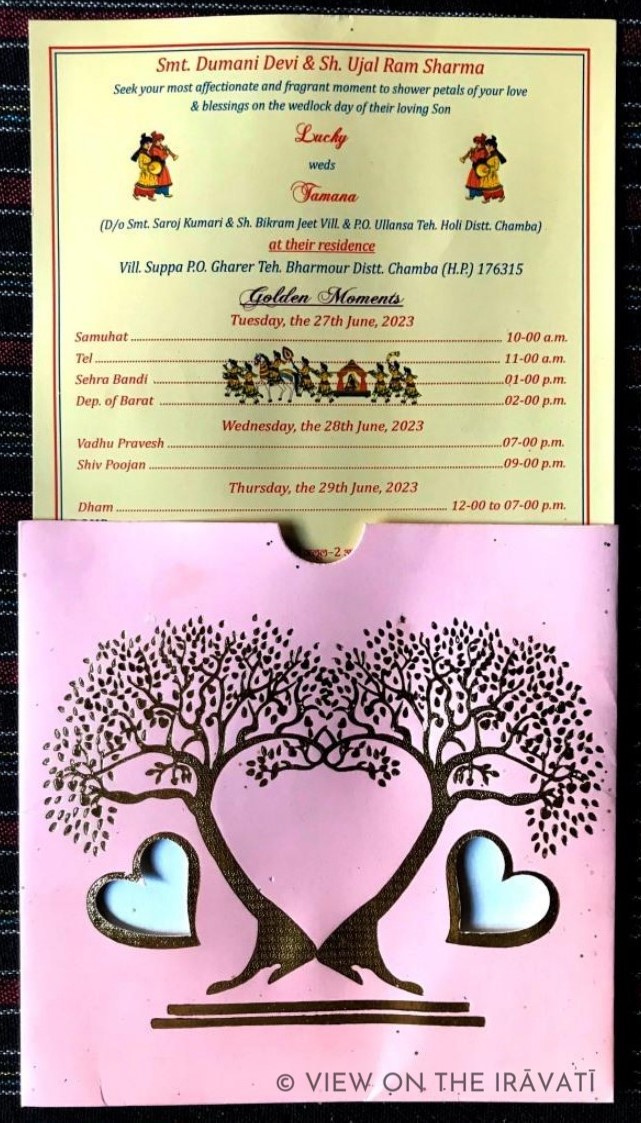
On the verge of the rainy season in 2023, a set of auspicious dates were packed with weddings (śādī) in this corner of Himāchal Pradeśh. One of those weddings was of my husband’s cousin, Lucky, to a woman named Tamanā from a village across the valley.
Regrettably, I wasn’t in the frame of mind to play armchair anthropologist and make detailed notes of what exactly was happening during the wedding. I wasn’t even able to stay awake for most of the night-long rituals and dancing. Still, there were vivid and joyful moments that I’d like to stitch together to give some impressions of a Gaddī wedding. A more complete overview of the ritual stages of a traditional Gaddī wedding can be found here.
Family Background
Before we begin: in case you’re unfamiliar with the vast web of north Indian family relation terms, it might be helpful to acquaint yourself with this diagram.
Lucky’s wedding was a highly anticipated event in our extended family, for he is the son of our māmā and māmī, who have endured several major losses recently. From the time I returned to India in mid-2022, māmī has been checking in with me to make sure that I wasn’t going anywhere. In the midst of building a house and anticipating our jethānī’s (sister-in-law) imminent delivery, we oriented all tasks around being able to attend this wedding.
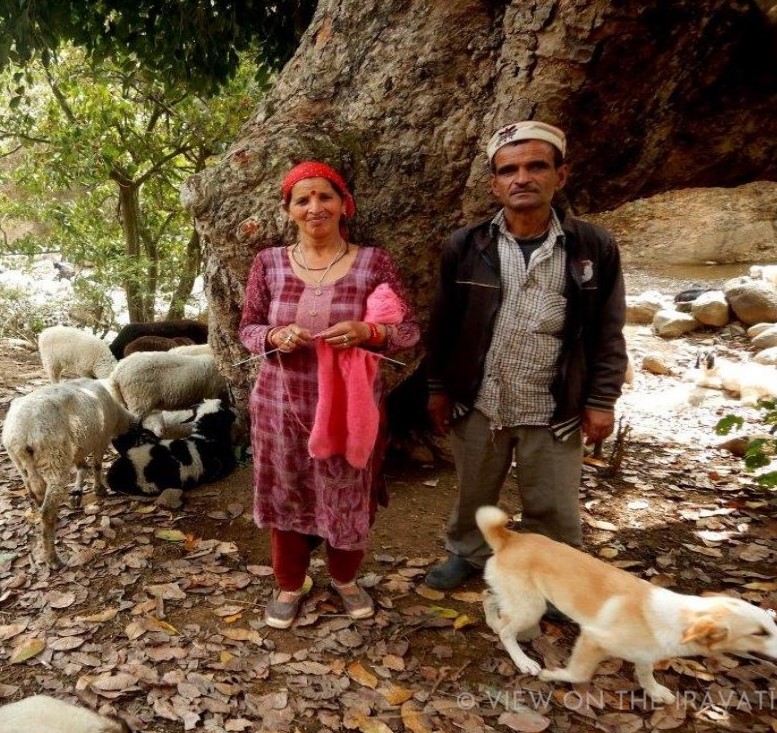
Despite the highly gendered and hierarchical system of family names in Hindī, or perhaps because of it, there isn’t a name for “cousins” that applies across relations from both sides of the family. Perhaps denoting the closeness that exists among many Indian extended families, most cousins address each other as “bhāī” (brother) and “dīdī” (sister).
Even though the māmā is a maternal relation, my husband and Lucky are “brothers”, which makes me Lucky’s bhābhī, or sister-in-law. Bhābhīs have several key functions in a marriage, as you’ll see below, and this post is admittedly bhābhī-centric.
Wedding Timeline
Before I get lost in describing my scattered impressions of the wedding, I wanted to give a general overview of the four-day long event. In Gaddī a groom is called the “noā laḍa” (lit. “new husband”) and the bride is called the “noī laḍī” (lit. “new wife”).
Even this section is biased and incomplete as I’m narrating the events from the perspective of a participant from the groom’s side of a wedding party. Later this month, I’ll attend a female relative’s wedding and hope to write a separate post on the wedding experience “from the other side” soon.
Day 1
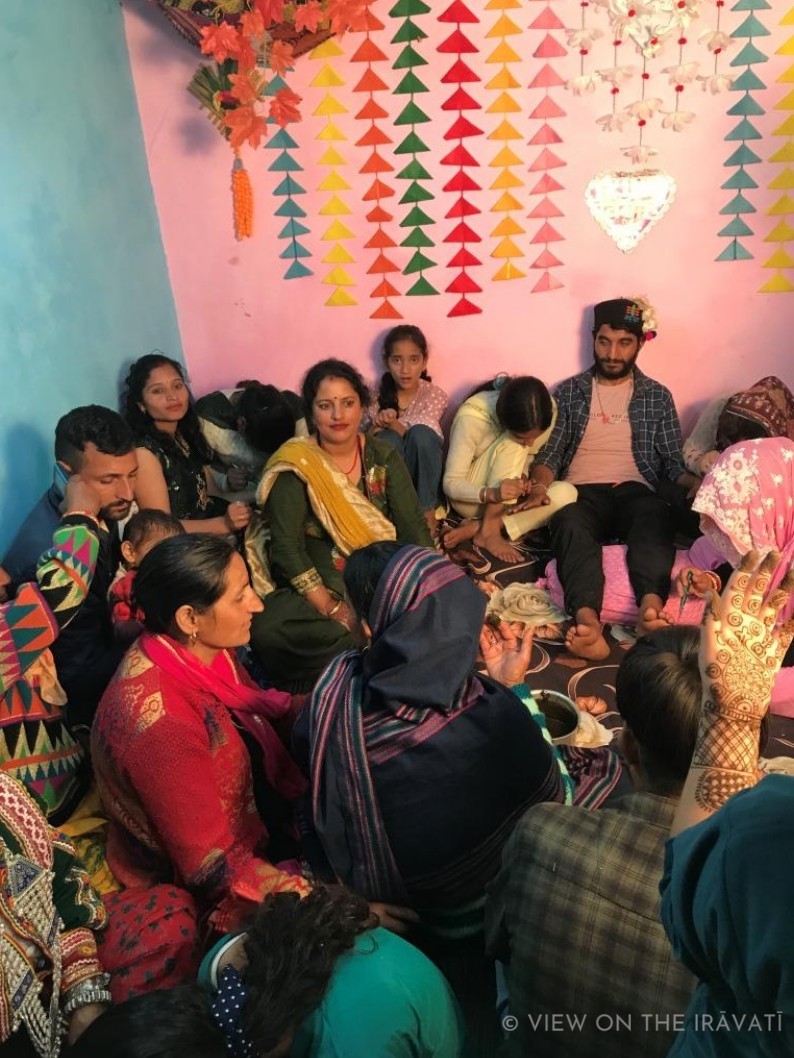
Haldī/Mehndī: In most parts of India, the first stage of preparation is the haldī (turmeric) ceremony. It’s usually not counted as one of the days of the actual wedding. All close family members and guests from the village congregate for the first collective meal followed by the smearing of the groom and each other with a paste made of turmeric, flour, and mustard oil for purification. After this mixture is rubbed off, we all sit in a room and apply mehndī (henna) to the hands and feet of the groom and each other, marking the first of many stages of beautification.
Day 2
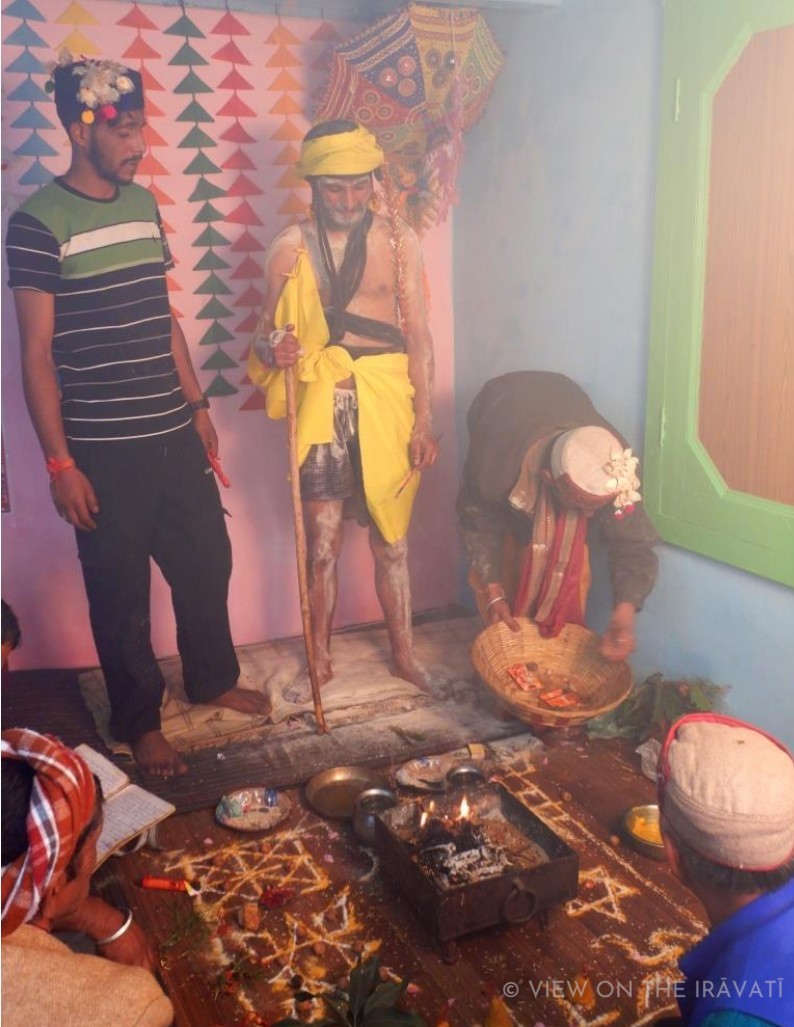
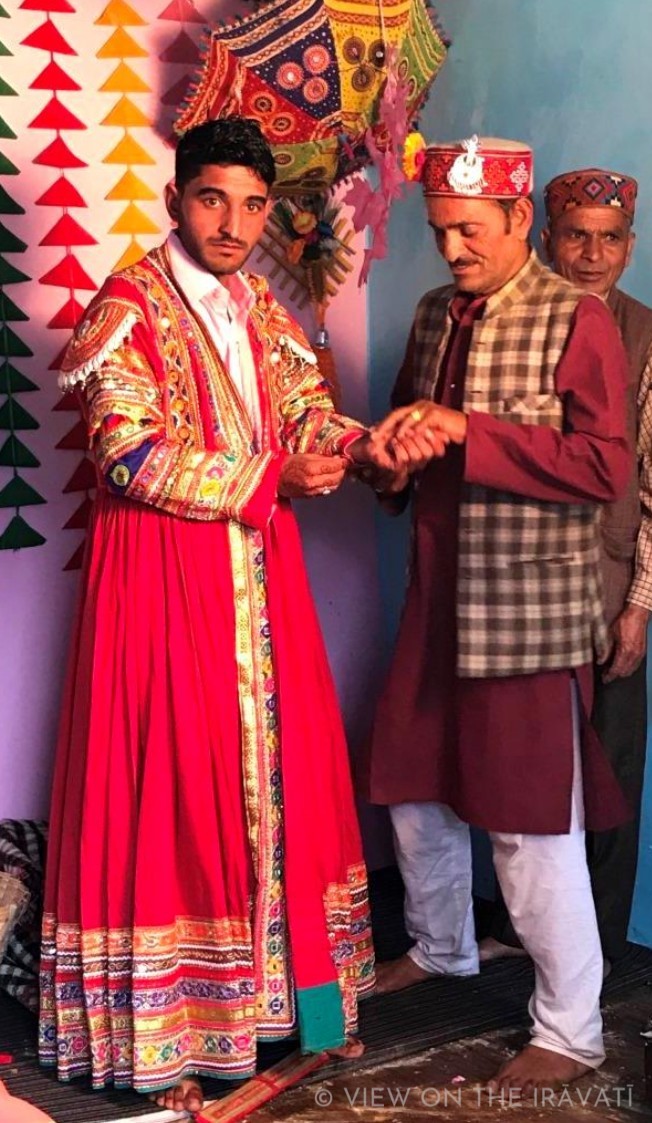
Preparation of the groom: This included a havan (fire ritual), bathing, and a re-enactment of pre-wedding jitters in which the groom dresses as a renunciate yogī (jogī) and attempts to flee, only to be stopped by the bhābhīs. He is then washed, shaved, and dressed in an ornate red robe (olanchā) and headpiece (G. herā; H. sehrā).
Gifts and garlands (hār) of rupee notes are given as the groom and the male members of the party prepare for the barāt, or the trip to retrieve the bride from her village. There, the actual wedding rituals will commence and the bride’s side of the family hosts a feast (dhām). There’s usually a specific time (muhūrt) pre-arranged by a paṇḍit for when the main ritual transfer of the bride from her natal family to the groom’s family should take place. There’s a lot to unpack about this view of what marriage entails that I won’t attempt here.
All the womenfolk from the groom’s side stay at the groom’s village – creating, for me, a strange feature of Gaddī marriages: the mothers of the bride and groom are never together in the same space during the entire marriage celebration.
Day 3
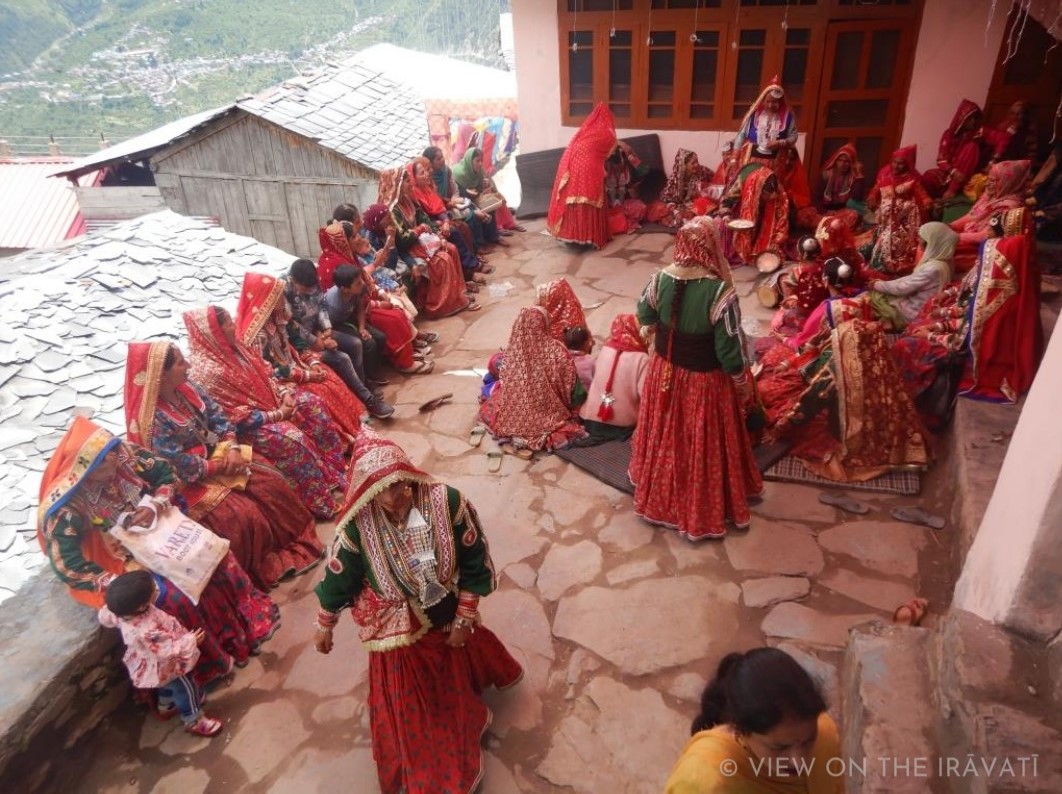
Paḍhuā and arrival of the bride: As a female relative, I was only privy to the events at māmā’s home, which were wonderful and usually overlooked since they “only” involve women. During paḍhuā, all the women who have been married into the groom’s village and live there dress in traditional Gaddī dress, the luānchārī, and do a ceremonial dance for the sake of creating an auspicious atmosphere for the new bride to arrive in. This ceremony utterly captivated me and has a disproportionately long section below.
The pace of the day pivots upon the return of the barāt along with the new bride and her retinue (pahcheṅkī). Their arrival in the evening is met with great fanfare and the second major set of rituals to solemnize the wedding are conducted alongside an all-night form of Śhiva worship particular to Gaddīs called a naulā (in some cases this is held on the first day). There’s usually multiple forms of music, some traditional and some modern blasted on a speaker, accompanied by dancing all night long.
Day 4
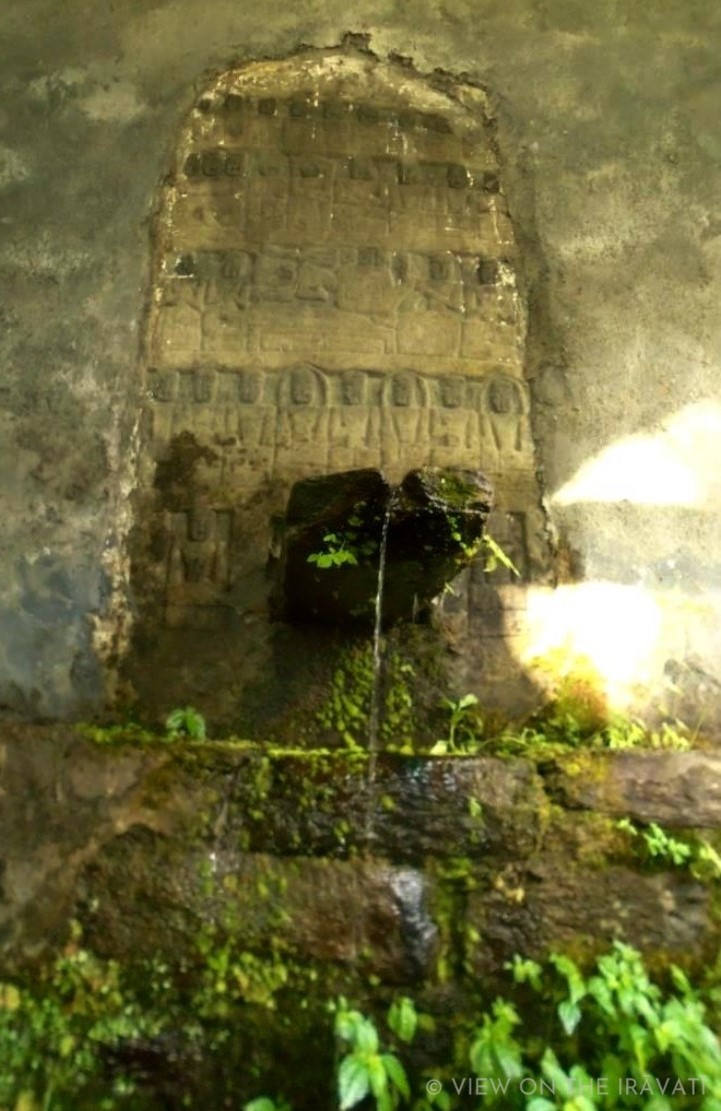
Pānihār pūjan (worshipping the water source): A few hours after sunrise, the bride, dressed in a luānchārī, carries a pot of water from the village’s main spring, which is often adorned with an engraved water stone.
Amid ongoing dancing and merriment, gifts are given and duly noted as a professional photographer captures each hand over. This day sees the final dhām (feast) for all the guests and some people start making their weary way home.
In the afternoon, the bride, groom, and three other people from the groom’s family (so that there are an odd number of people in the party) go back to the bride’s village to spend a night there. This is known as harpherā.
Setting the Scene in Supā
The wedding took place at my mother-in-law’s (G. khākho , H. sās mā) natal home, where māmā and māmī live when they’re not out with the flock. This village, named Supā, or Hupā in Gaddī, sits across the Budhil Valley from Bharmour and is situated at 9,180 feet (2,800 m) above sea level.
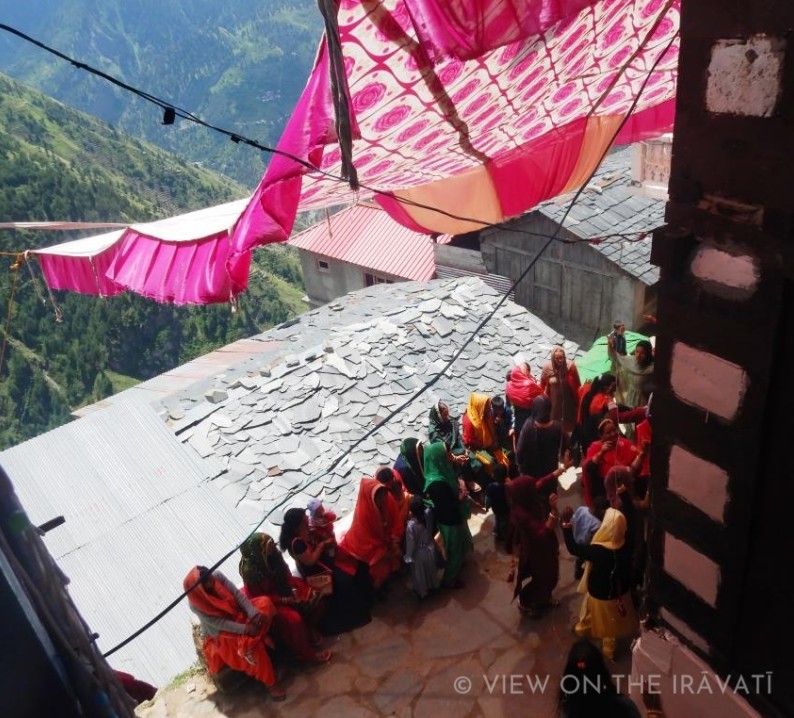
Few things are as old as they appear here, but this house was built at least 60 years ago, with rock walls, Himalayan pine beams, and a slate roof. This is a version of a style of architecture found throughout Himāchal called khadī (G) or “kāṭh kunī”(P) (literally “wood-corner”, from Sanskrit “kāṣṭḥa-koṇa”).
A large cobblestone courtyard between three nucleated households of my khākho’s father and her two uncles served as the main arena for many of the wedding’s events. Most importantly it served as the primary dance floor for several days and nights of dancing.
All guests stayed at homes in the village. They are almost exclusively family members and their extended families, which still amounted to over a hundred people. My husband and I stayed in a neighboring home, with a room to ourselves, which was a vital luxury for which I will forever be grateful.
Dancing with the Clouds
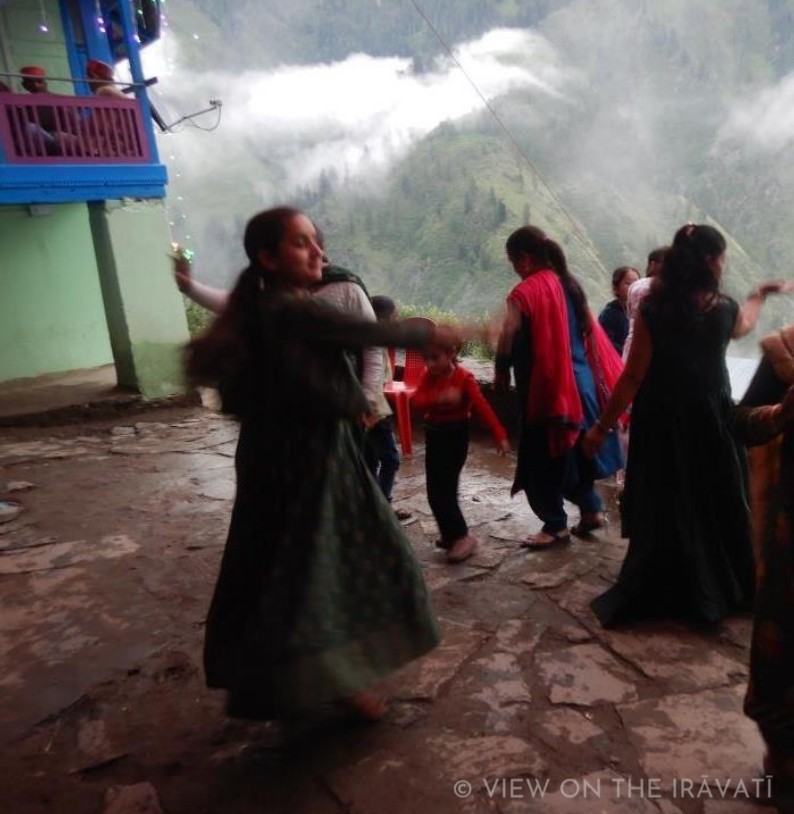
It took me a while to appreciate all the things a village wedding is, for I grew up in the empire of entertainment. There are no movies, amusement parks, malls, clubs, or concerts here. More-so than major holidays like Śivarātri and Dīvāli, a wedding provides a break from the mundane and chance to be entertained – in addition to wishing the new couple an auspicious start to their married life.
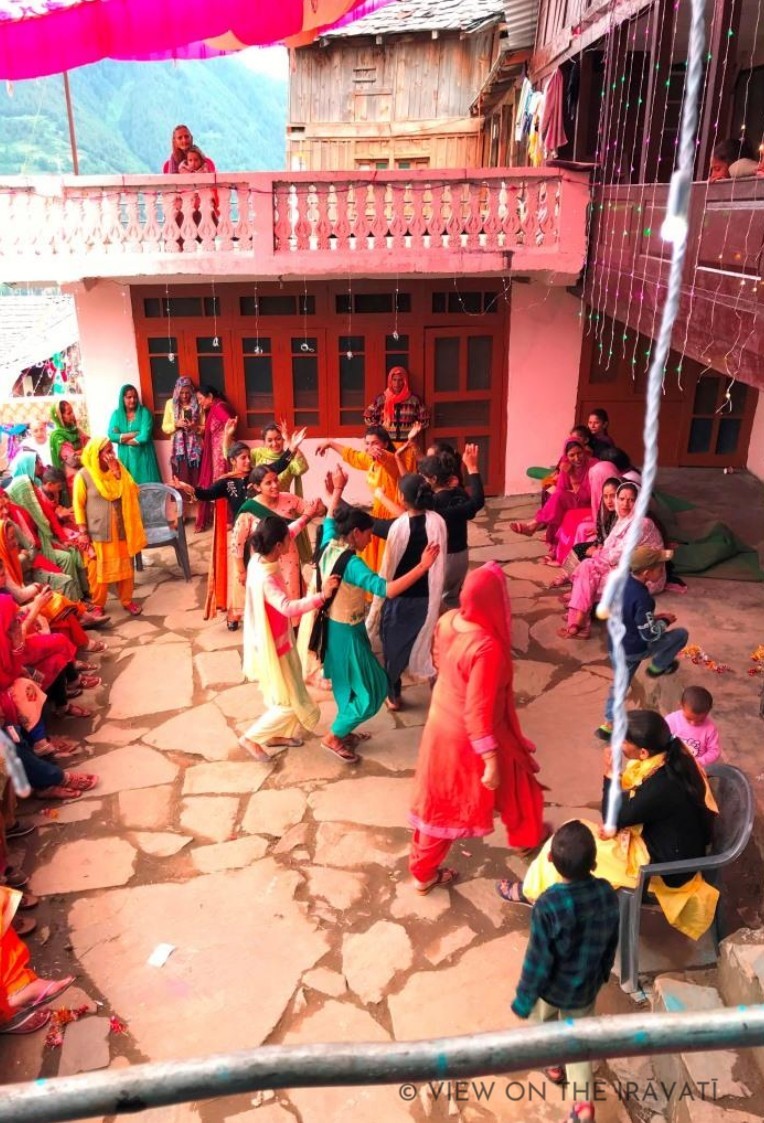
Dancing, nachā, is the social glue and central thread of the lengthy celebration.
For several days the women have less cooking and cleaning. They wear their finest adornments and release the backlog of domestic tension on the dance floor. Gathering on verandas, they gossip, catching up with relatives or other women who were reared in the village and then married out of it.
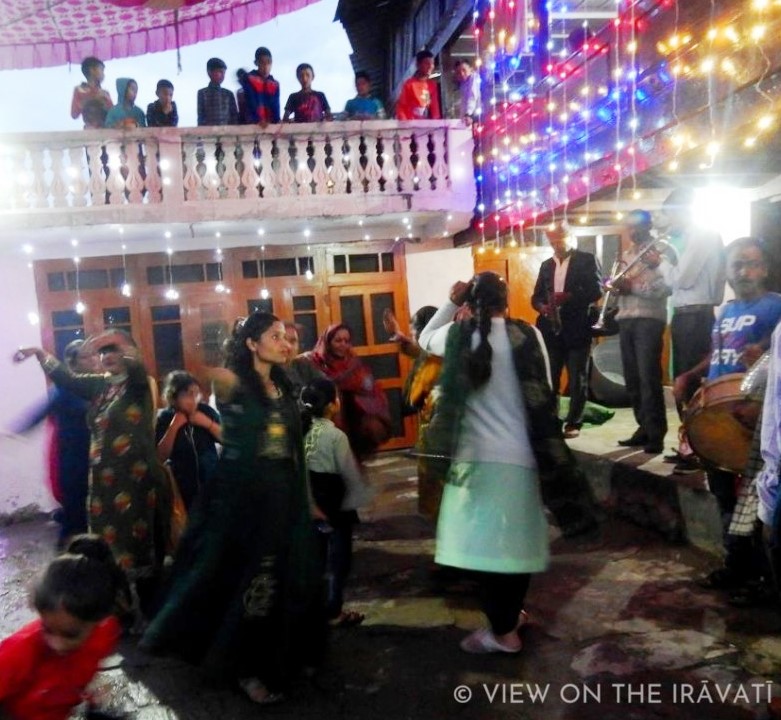
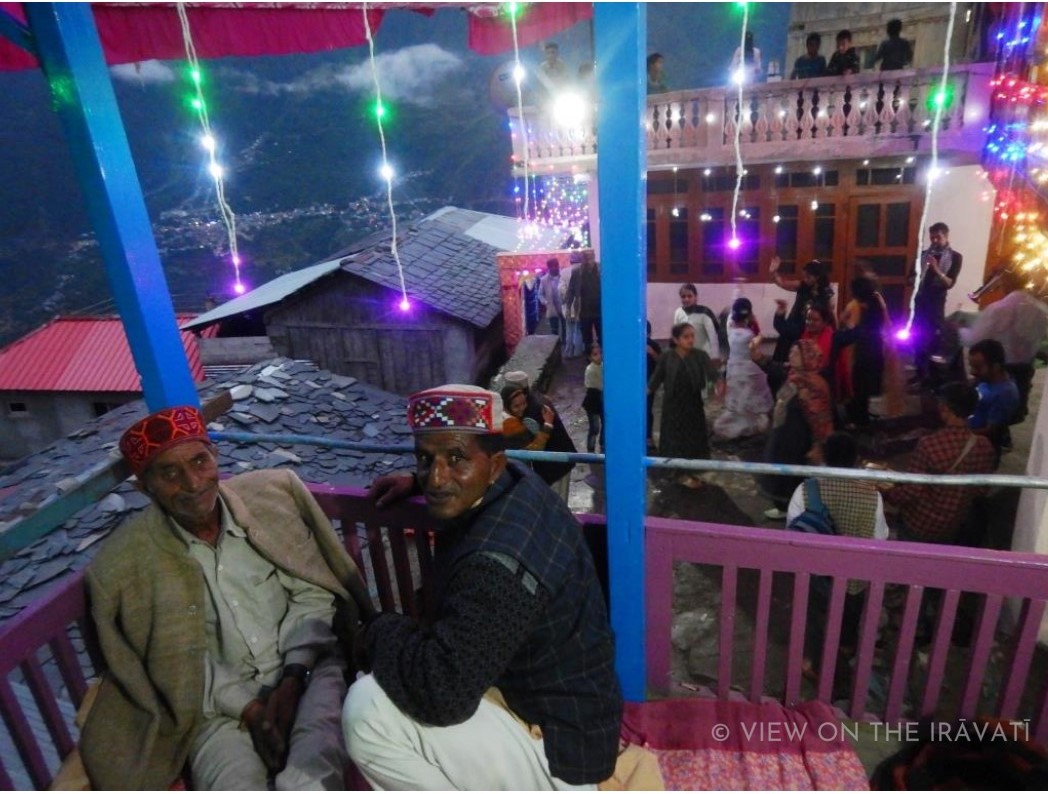
The men mostly drink, which they do on all occasions, but during a wedding they do so with even greater gusto, there being no shortage of drinking companions. As the night progresses they usually make a flailing appearance on the dance floor. In preparation for the wedding, many people brew their own rice, sugar, and barely-based spirits called sūra.
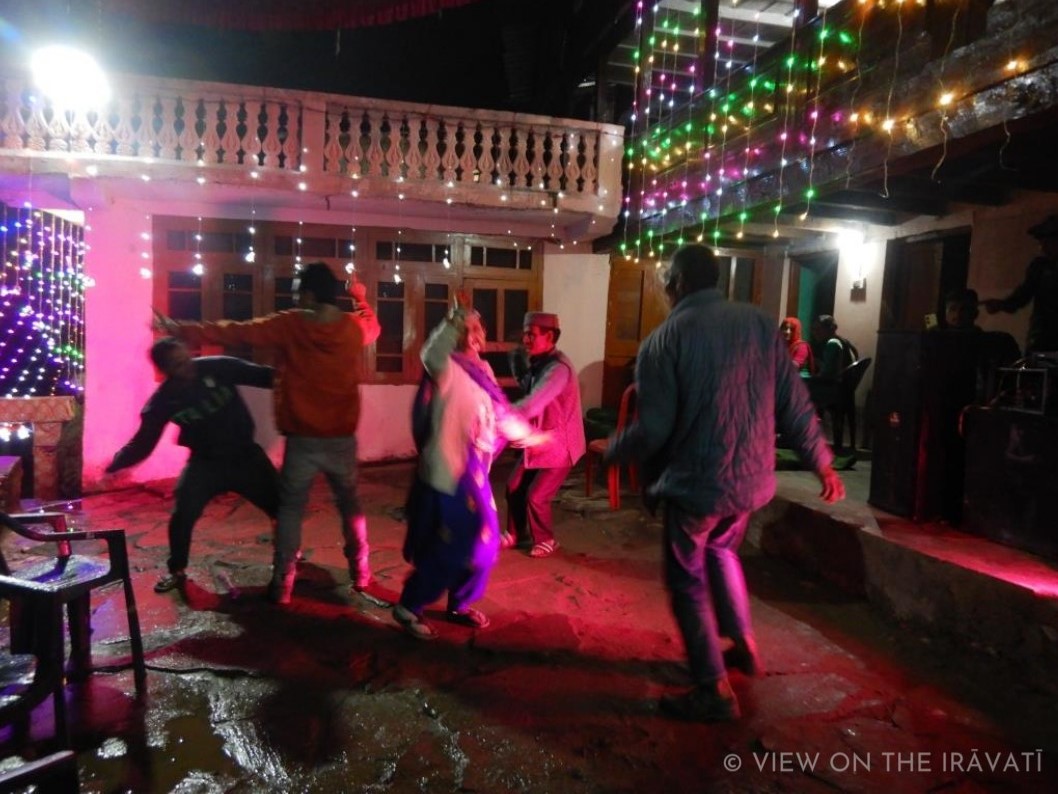
Jognū Ceremony
Clad in a yellow dhotī, makeshift dough pendants dangling from his ears, and besmeared with ash, Lucky made a run for it. The jogī or jognū ceremony was one of the more light-hearted moments of the wedding. Lucky really looked the part of a yogī, or jogī in the colloquial pronunciation, who is preparing to turn his back on worldly affairs; inconveniently on the eve of his wedding.
Bhābhīs being bossy
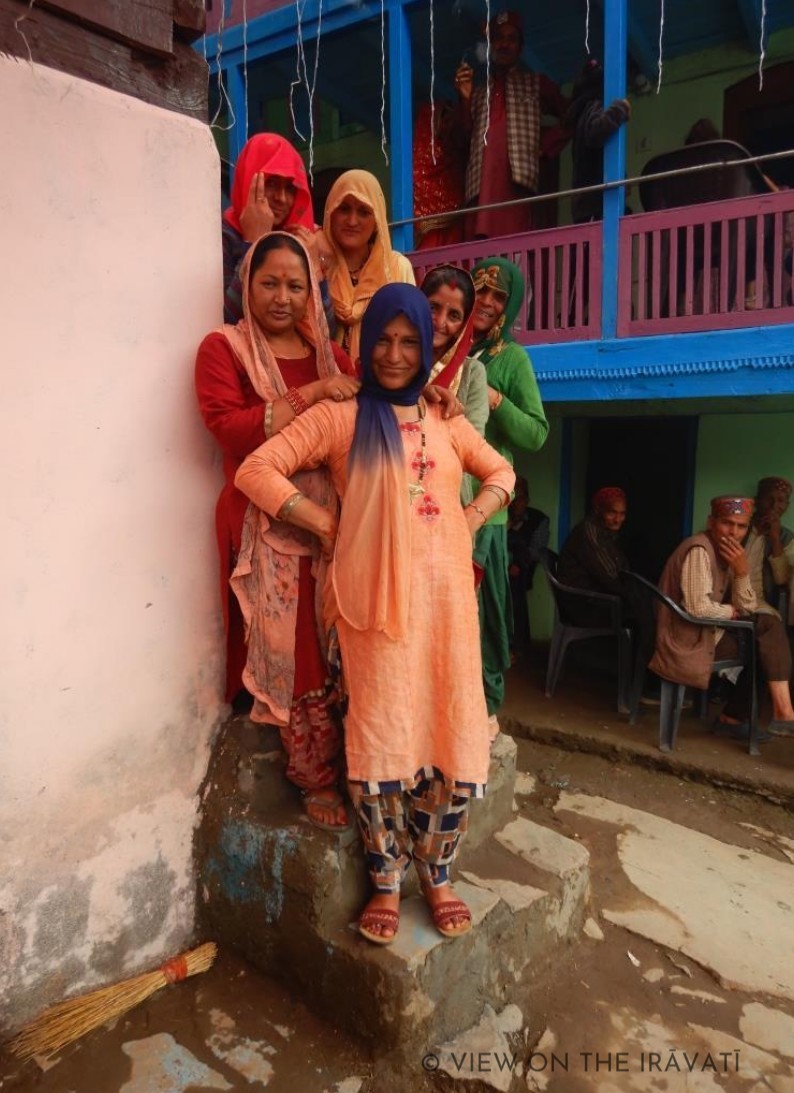
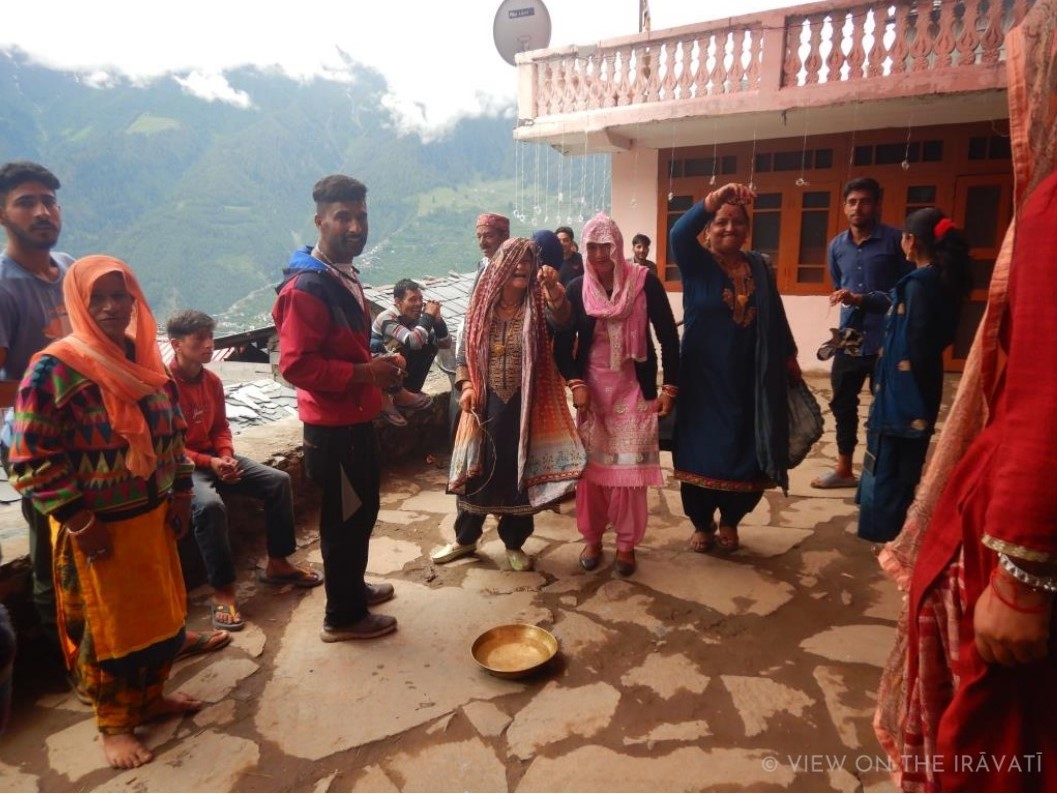
Imitating a spiritual pilgrimage (G. jātar, H./S. yātrā) he made several circumambulations of a brass dish filled with water, representing the local holy lake Maṇimaheśh. Behind this dish, the bhābhīs stood; ready and armed with sticks to beat some sense into the faltering groom.
On his last circuit around the dish, we launched at him accompanied by a roar of laughter.
After stuffing a few coins, flatbread, and grains into his simple bag, he is persuaded to resume his role as a groom and prepare for his entrance into the life of a householder. In olden times, he would also be bribed with promises of sheep and goats from older male relatives – promises they were obliged to make good on.
While I haven’t come across similar enactments in other North Indian wedding rituals (please let me know of any in the comments!) there is an interesting tradition in South India, particularly in Tamil Nadu and Andhra Pradesh called Kaśhī Yātrā. The basic idea is the same, though the supporting props reflect differences in local cultures.
Preparing the groom
Now that the groom has resolved to proceed, he bathes and starts the lengthy beautification process before the barāt.
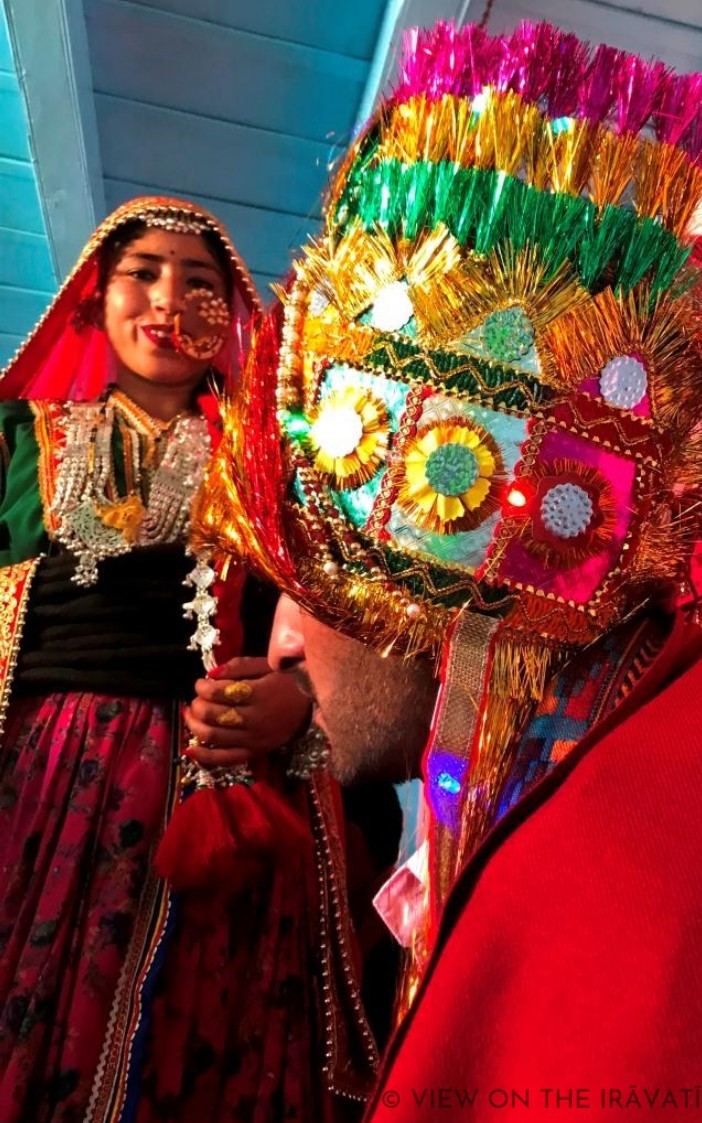
The signature dress of a Gaddī groom is the full-length, pleated, bright red olanchā. Here some helpful relatives, in this case his boiyā (father’s sister’s husband), assist him in putting on this ornate robe.
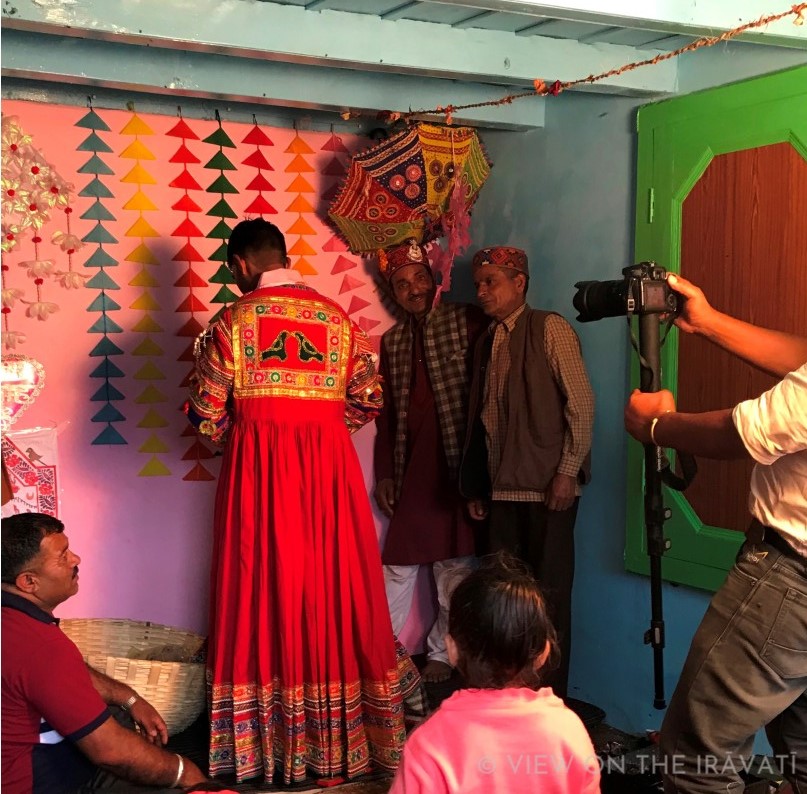
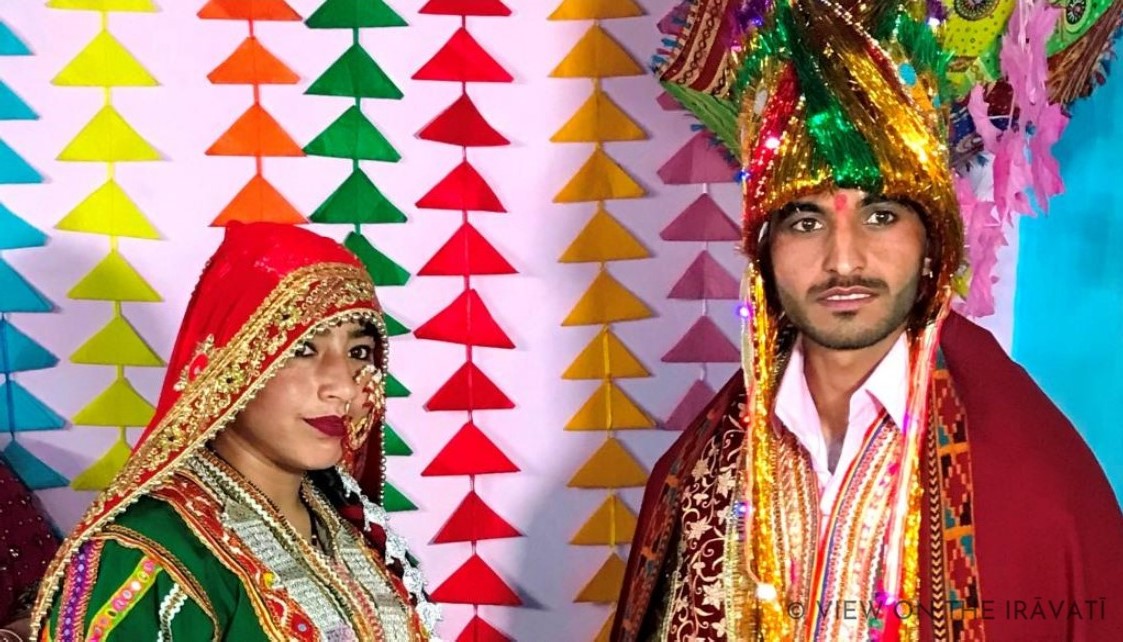
In north Indian wedding ceremonies, both the bride and groom veil their faces. Usually the groom’s veil consists of a string of beads, called a sehrā, draped from a turban and tied (bandhi) around his head. Hence this stage of the wedding is known as “sehrā bandhi” in Hindī, and “herā bandhi” in Gaddī. The style of herā popular among Gaddi’s today resembles an elaborate Christmas decoration.
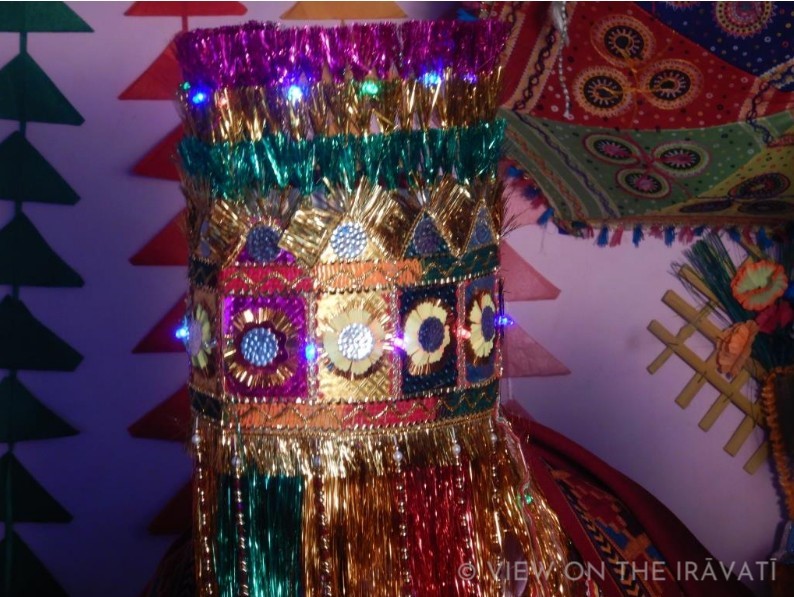
This electric herā also blasted a high-pitched loop of the Gayatrī mantra a la Anuradha Paudwal’s ubiquitous version. Out of mercy I asked Lucky if he wanted it turned off for the long round of photos; we eventually found the switch.
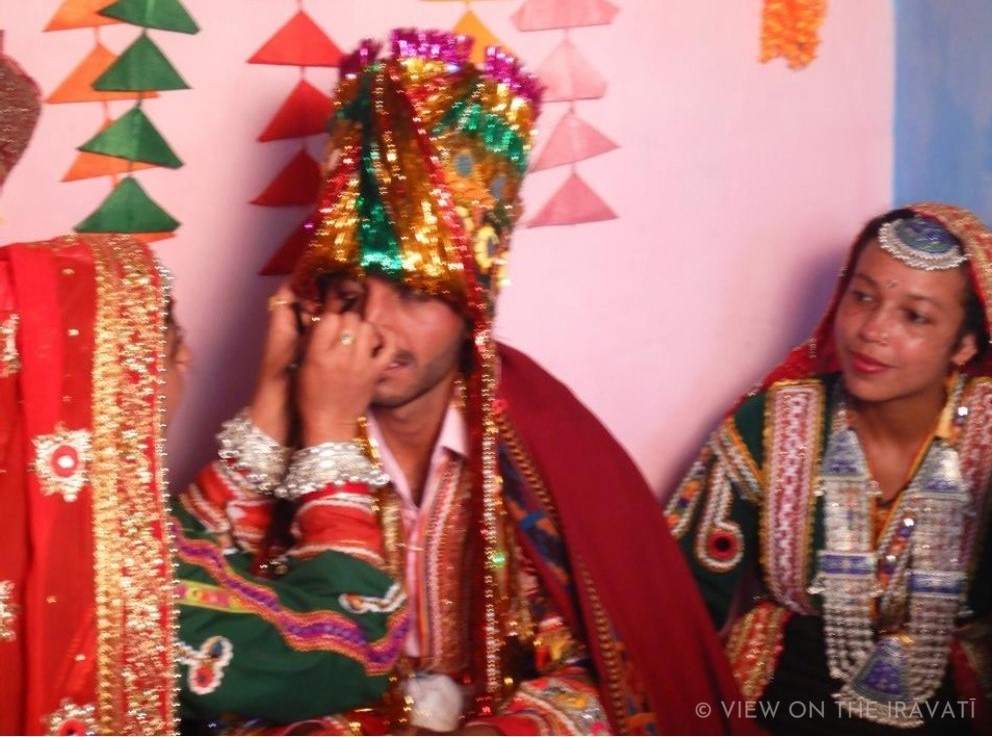
After the groom is all fitted out with his wedding gear, the bhābhīs come back for their final duty of the day: doing the his make-up. Cosmetics applied include nail polish, eye-liner (kājal), and lipstick.
Spectacle before the Barāt
As you can probably sense by now, a Gaddī wedding has no shortage of vibrant scenes; the groom’s departure with the barāt forms one of the grandest.
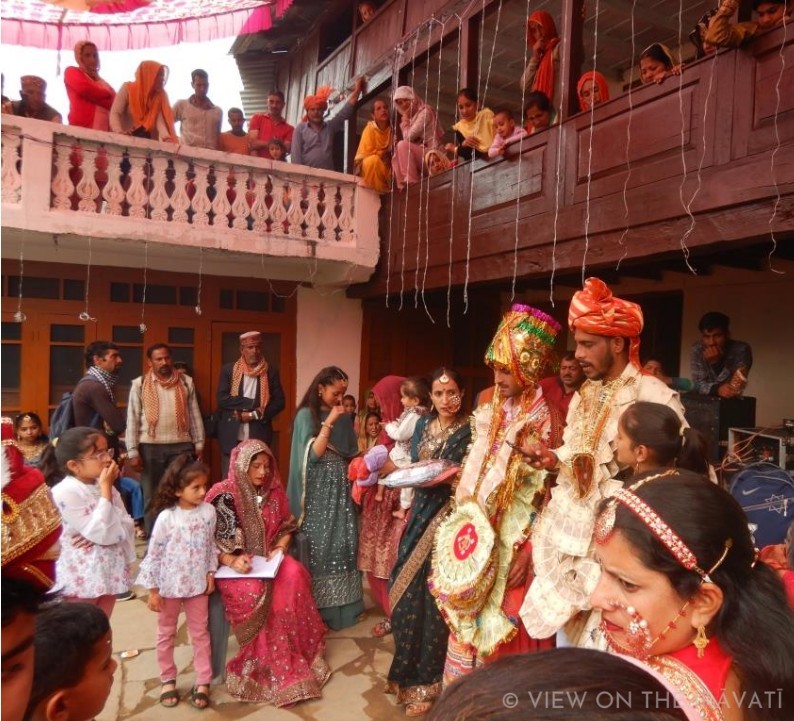
This picture encapsulates the joy, attention, and accounting which take place just before the barāt. The groom in the red olanchā and best man (pahcheynk) in the white cholā pose for a seemingly endless series of pictures as various relatives give them gifts and garlands.
The seated woman is a trusted bhābhī, taking note of what gifts each person is giving the groom. This register is then consulted before attending the wedding of a relation of one of these attendees so that one may give a gift in kind.
Here, in a wonderful inversion of cultures captured by one of my nieces, I am on the left wearing an almost complete luānchārī and my husband is on the far right, next to the best man, wearing a shirt of my brother’s boxing gym back in California.
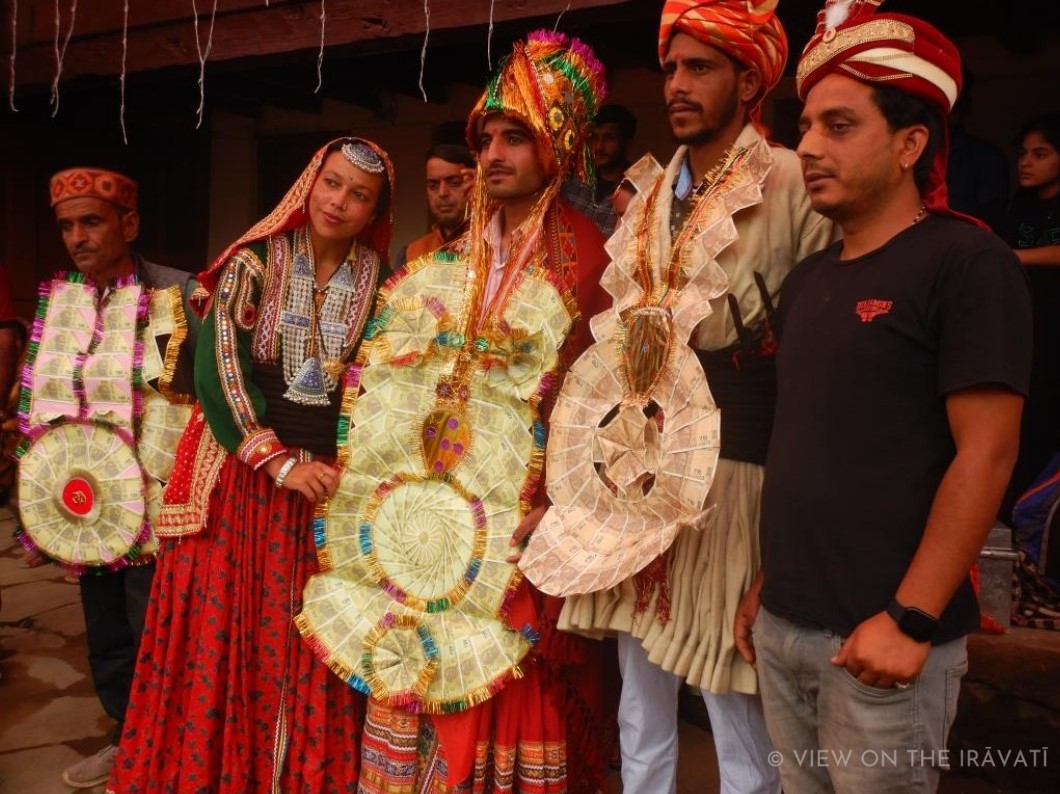
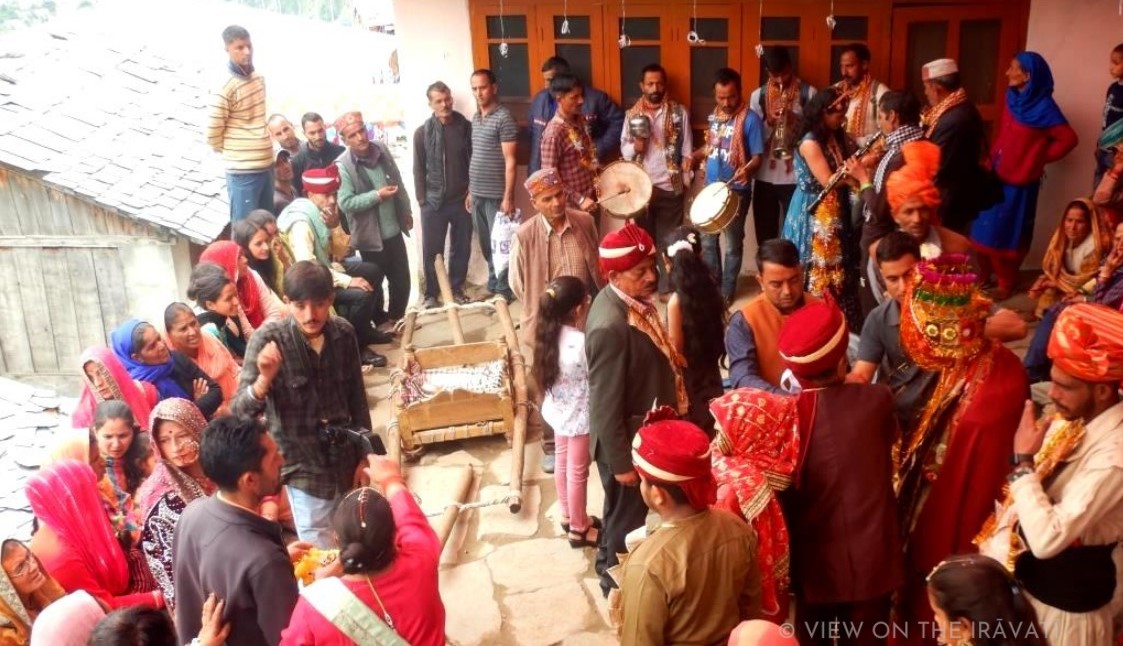
The groom’s vehicle for this affair will be a palanquin (pālankī); though once they reach the road the barāt will make the two-hour journey to the bride’s village by car. The Gaddī barāt differs from the dozens of barāts I witnessed in Varanasi, where both men and women danced through the streets, surrounded by generator-powered lights, as the groom rode behind them on a horse.
Still, there was a brass band to serenade the beginning of a long, long night.
Paḍhuā
With all the men from the away with the barāt, participating in the main wedding ritual, I was curious what the women would be up to. The evening was tame, with singing and dancing in a small room; little did I know the wondrous treat the next day held in store.
Bright and early, all the women bathed, washed their hair, and dressed in their luānchārīs. With their cascading locks of hair left open, they congregated in the stone courtyard of māmā’s house. Sitting in rows, the 40 or so women braided each other’s hair in elaborate plaits, incorporating red yarn and silver ornaments, most prominently the chonk on top. This sits at the crown of the head, making a graceful peak in the bright red, sequined chūnnī placed over it.
The following event was a spectacular show of feminine solidarity as all the women prepared the village for a new sister to arrive in a ceremony called “paḍhuā.”
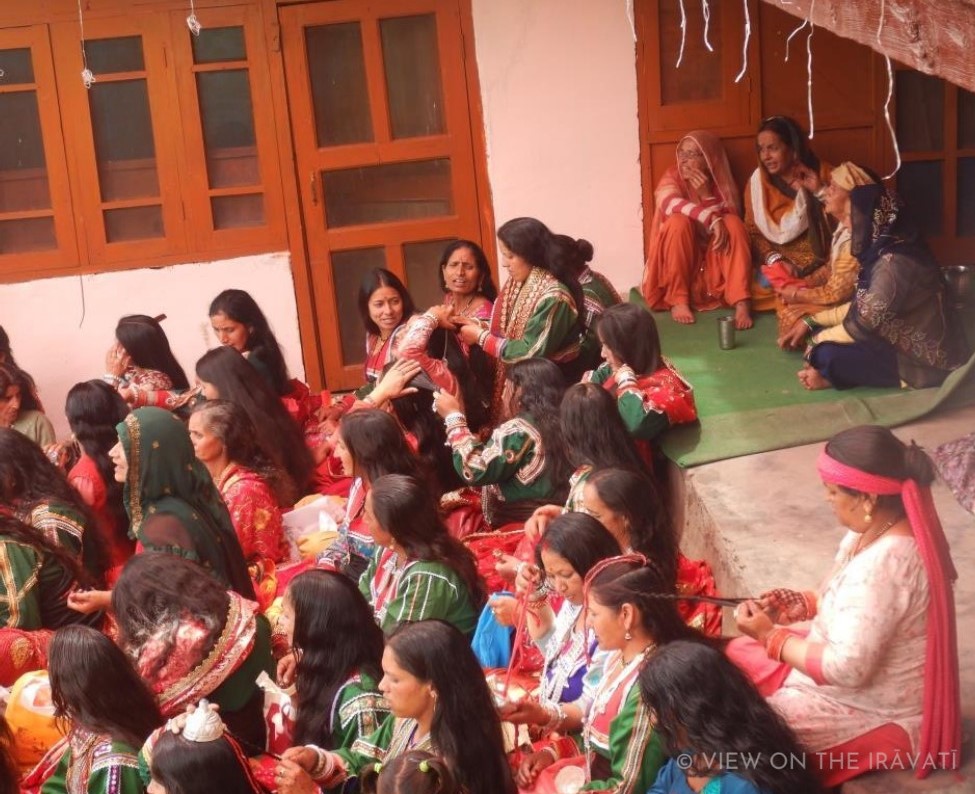
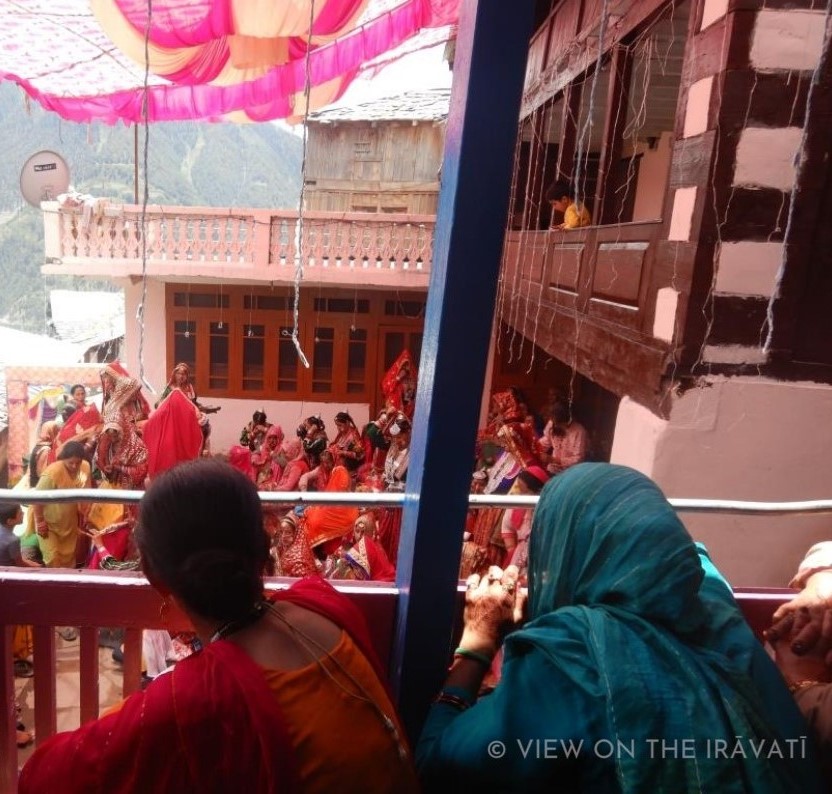
This is an occasion that is specifically for the all the village bahūs – or women who married into the village. Women born here, like my mother-in-law, or married women whose husbands aren’t rooted in this village, like me, don’t participate directly and watch on from the verandas.
Widows are also excluded, as they always are, from the litany of observances that married Hindu women do for the sake of “suhāg”- or their prosperity in the form of having a living husband. This Hindī and Gaddī word comes from the Sanskrit “saubhāgya,” which means “fortune” more broadly.
While such a narrow conception of what constitutes prosperity for women can be unsettling, the overall intention of this ritual is incredibly sweet: to cultivate a welcoming and auspicious vibe for the bride who is about to arrive.
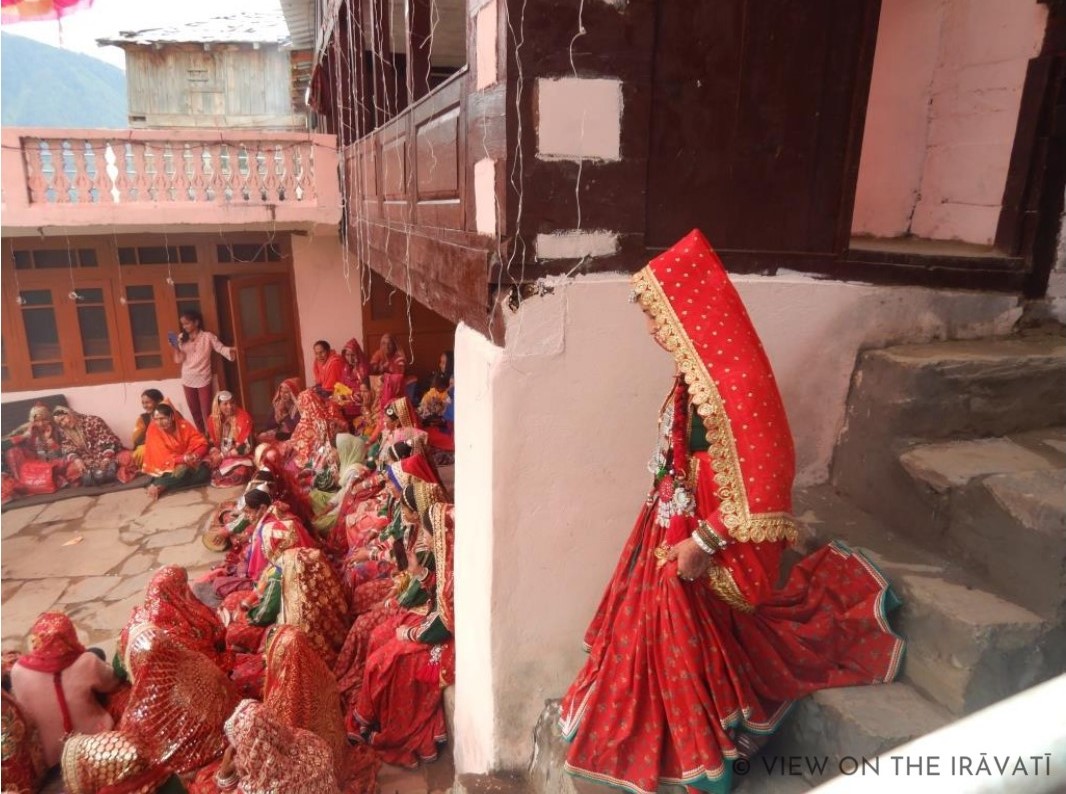
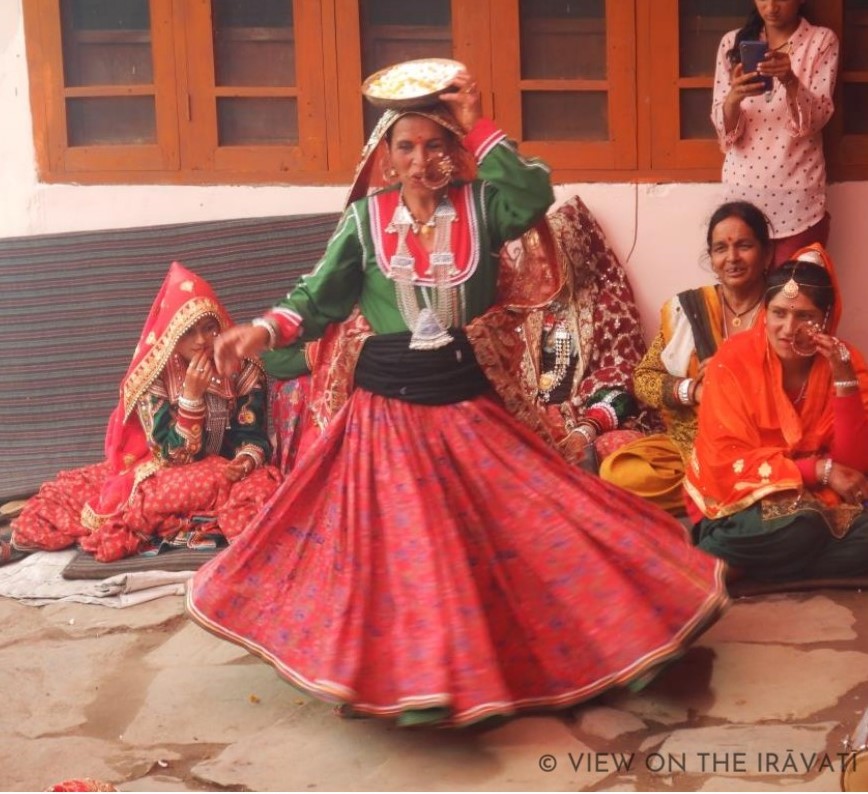
After all the participating women have descended upon the courtyard and they are completely decked out in their finery – the ceremony begins. Accompanied by ganthāl, a traditional mode of singing, the eldest bahū lifts a thālī (dish) filled with a sweet called boondi and guḍ (jaggary). Balancing the thālī with one hand on her head, she begins to spin back and forth in a gentle dance, before passing the thālī on to another woman.
In this manner, each of the village bahūs take a short turn dancing with the thālī of sweets on their head before the sweets are distributed amongst everyone as prasād (food that has been blessed following an offering).
Below is one of my favorite pictures from the whole wedding: māmī (dancer on the center-left) joining in the celebration as she anticipates welcoming her first bahū.
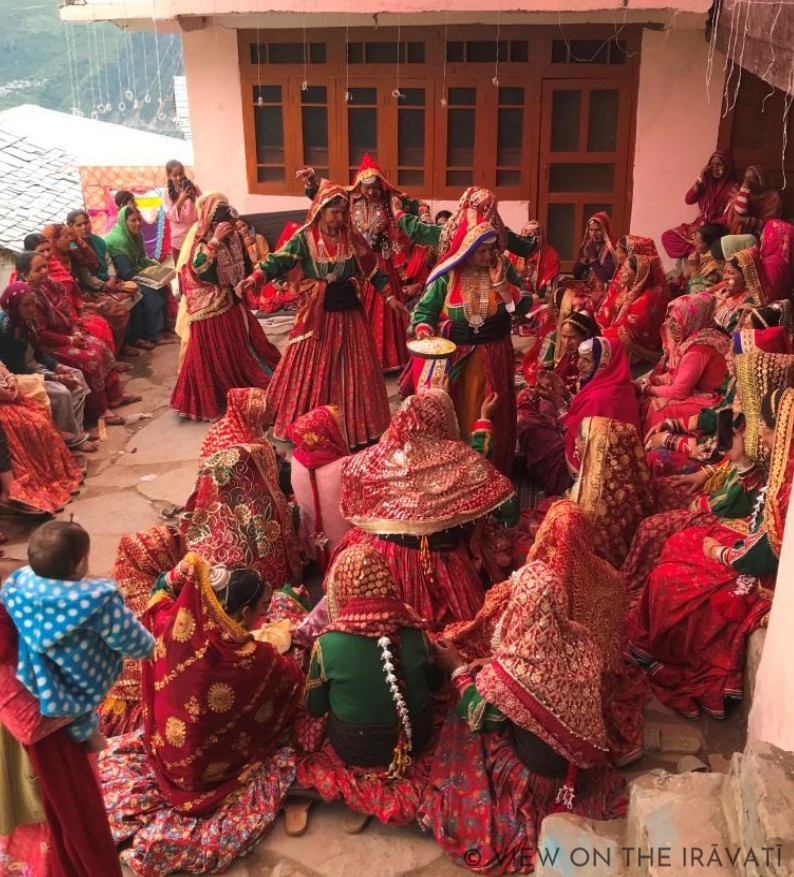
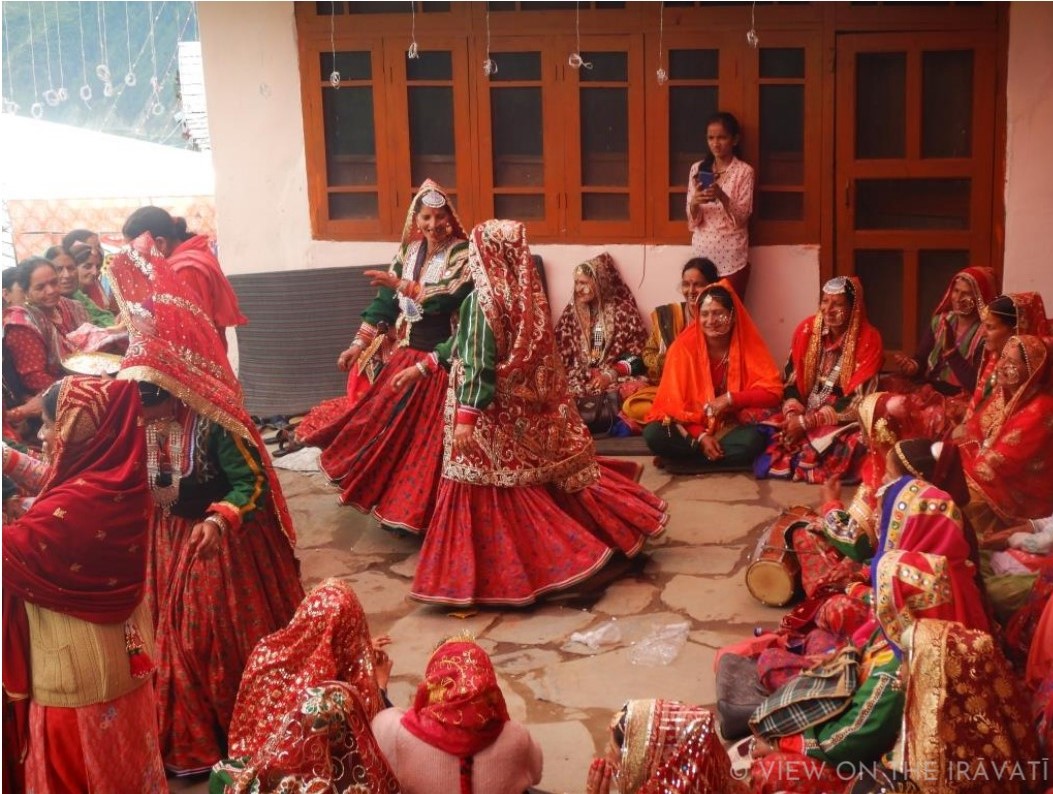
Whenever Gaddīs dance to their traditional music, there’s always a chance that the devtā, gods and goddesses, might join in. Someone dancing will usually start to flair a bit and look like they are entering a trance. Those who are able to call the deities into their bodies so that they can dance, are called chelā (m.) and chelī (f.). The dancing and pronouncement of a chelā or chelī, usually multiple ones, is a standard fixture in most Gaddī celebrations and even routine ritual observances.
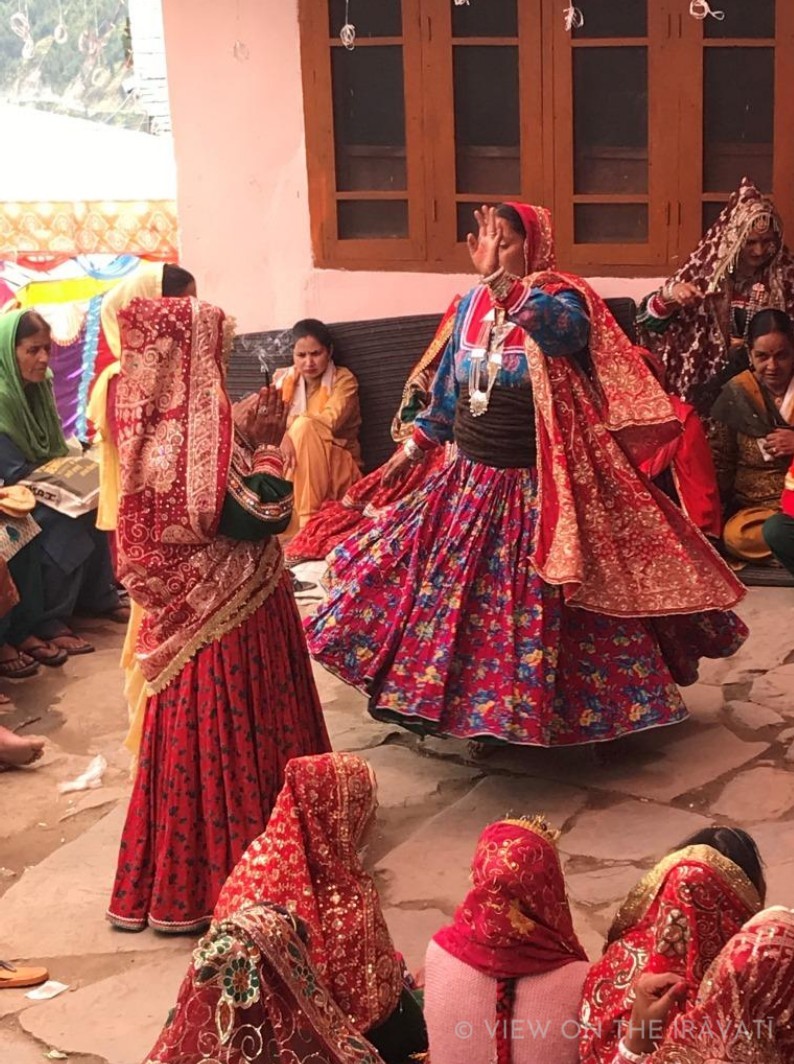
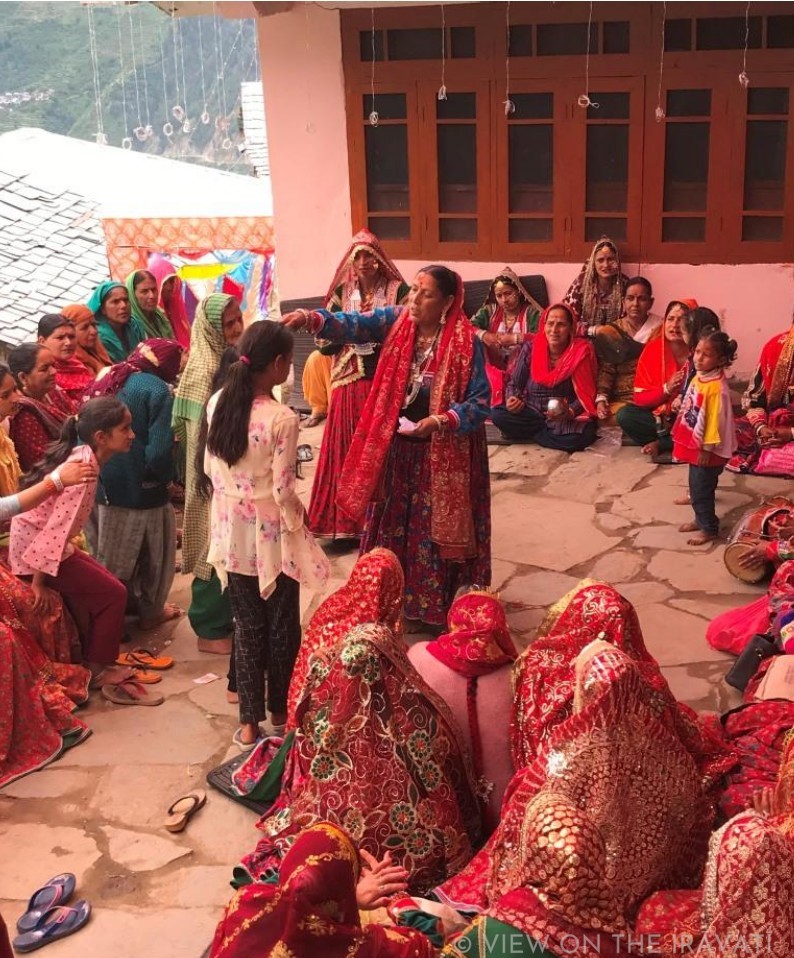
This is a culture which fully accepts the spontaneous possession by various deities. People send their children to receive blessings from the deity visiting the chelī as the paḍhuā winds up and we wait for the new bride and groom to arrive.
Scenes of the Sacred
Compared to other populations who receive the simultaneously stigmatized and coveted title of “scheduled tribe”, the Gaddī’s wedding rituals are far more in line with standard north Indian, Hindu customs. Still, their weddings are a hybrid with some ‘śāstric” (let’s say “orthodox”) elements and some that are wholly their own, like the jogī ritual and paḍhuā.
Oddly enough, due to a mix of gender restrictions and my own exhaustion, I effectively spent four days at a village wedding and didn’t even see the bride and groom get married! Hence, here I can only offer a few glimpses of the ritual landscape of a Gaddī marriage.
Maṇḍal
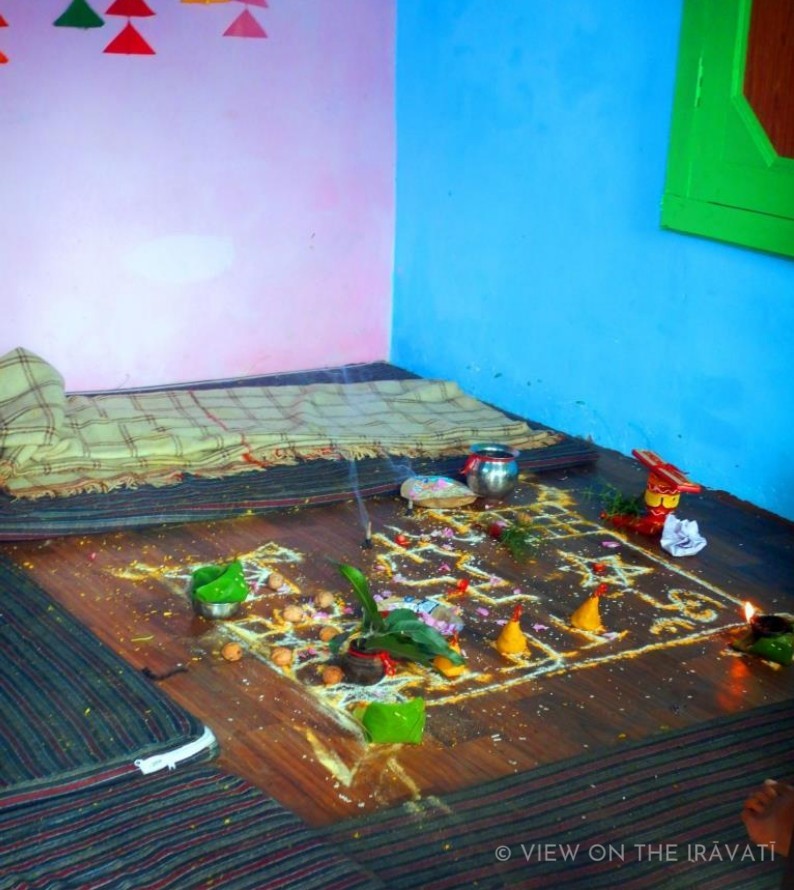
One of the primary ritual features of Indian-origin religions – such as Hinduism, Buddhism, and Jainism – is the construction of a maṇḍala (S) or maṇḍal (G/H). This is a testament to the wide influence of tantric modes of worship across traditions . While the original meaning of the Sanskrit word “maṇḍala” is something round, like a disk, in ritual practice maṇḍals are made of various shapes and sizes.
There are usually specific prescriptions for what they can be made out of, how they are oriented, and which mantras people say when creating them.
I asked a bright young relative about the ritual use of maṇḍals by Gaddīs and she replied that there are three types:
- Sāndhi – made when the māmī and nānīhāl (maternal relations) come during haldī
- Sumūrhat – made in both houses by the male relatives of the bride and groom assisted by a paṇḍit. This is the main maṇḍal around which the wedding ceremony takes place at the bride’s home.
- Naulā – made for the ritual worship of Śhiva
The first two are a necessary part of any wedding while the third can be optionally performed at a wedding and is a stand-along ritual that anyone could choose to perform on an auspicious occasion.
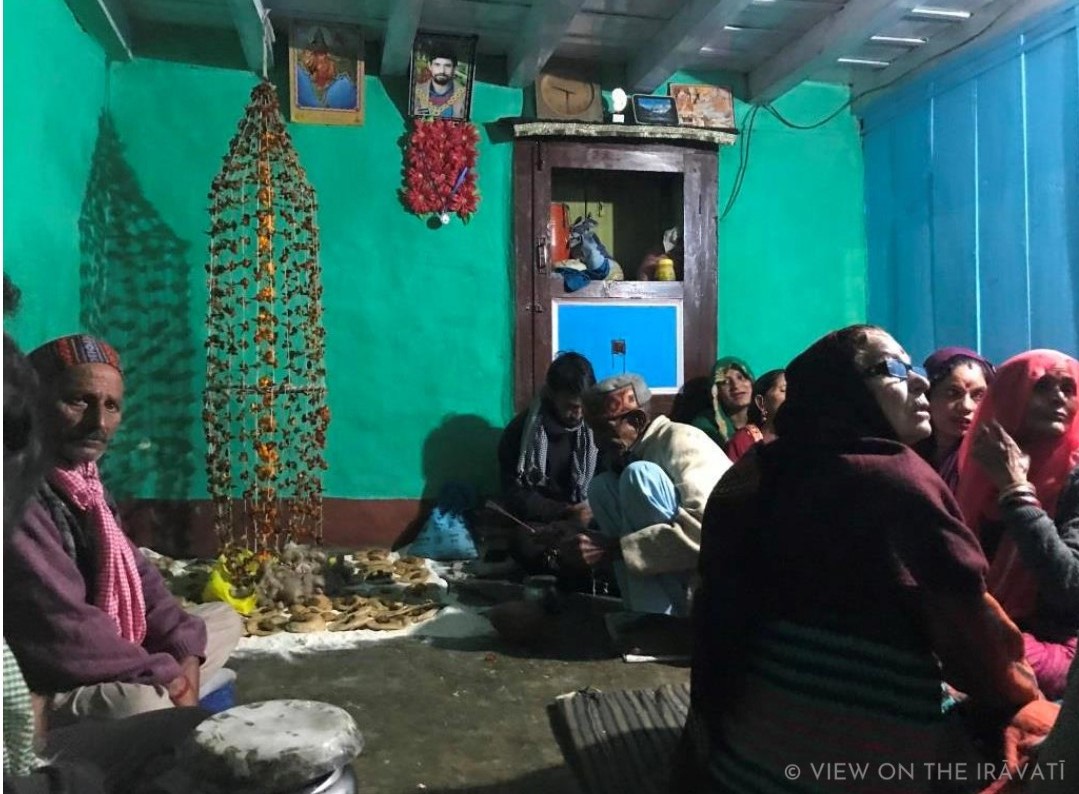
Here is a naulā maṇḍal, in the left corner, with a mālā (garland) made of wool and flowers suspended above it. This type of maṇḍal is the most distinctively Gaddī one. An 8×8 grid is made out of course flour on the floor and Gaddī food staples like bobarū (fried, leavened bread) and walnuts are placed at the 64 hubs. This is a picture from a different wedding, of Lucky’s cousin, which happened a few weeks later.
Bali
Another distinctive feature of Gaddī marriages is the sacrifice (bali) of a goat before the official entrance of the bride – a ceremony known in most parts of India as “gṛha praveśh,” though sans sacrifice.
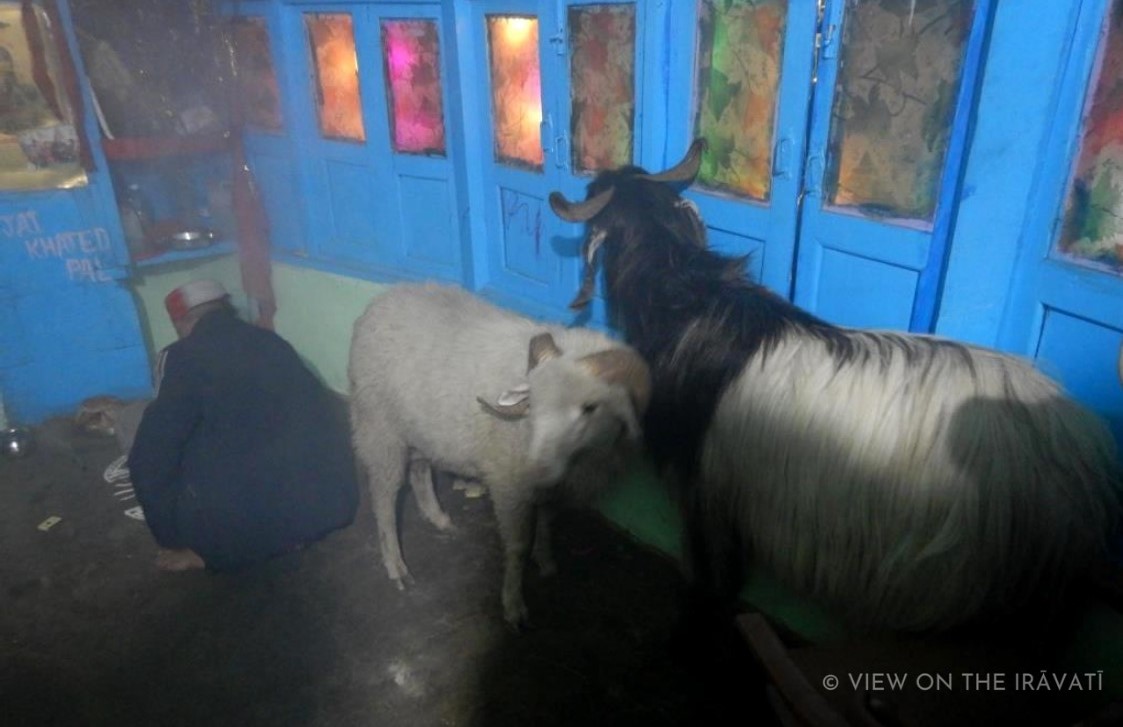
Here a sheep and a goat are also brought into the family’s temple room, the main altar can be seen on the right. The bride will sprinkle their feet with water; when the animal shakes this water off, it is seen as a sign of accord and they are then ritually sacrificed. The meat, also a form of prasād, is cooked to feed the wedding guests during the main feast (dhām).
Though the idea of animal sacrifice tends to offend people, I can’t think of a more ethical way to eat meat. These animals are loved and cared for their whole lives as they roam spectacular mountain pastures. When the time comes for them to become food, they are worshiped and even requested to become an offering.
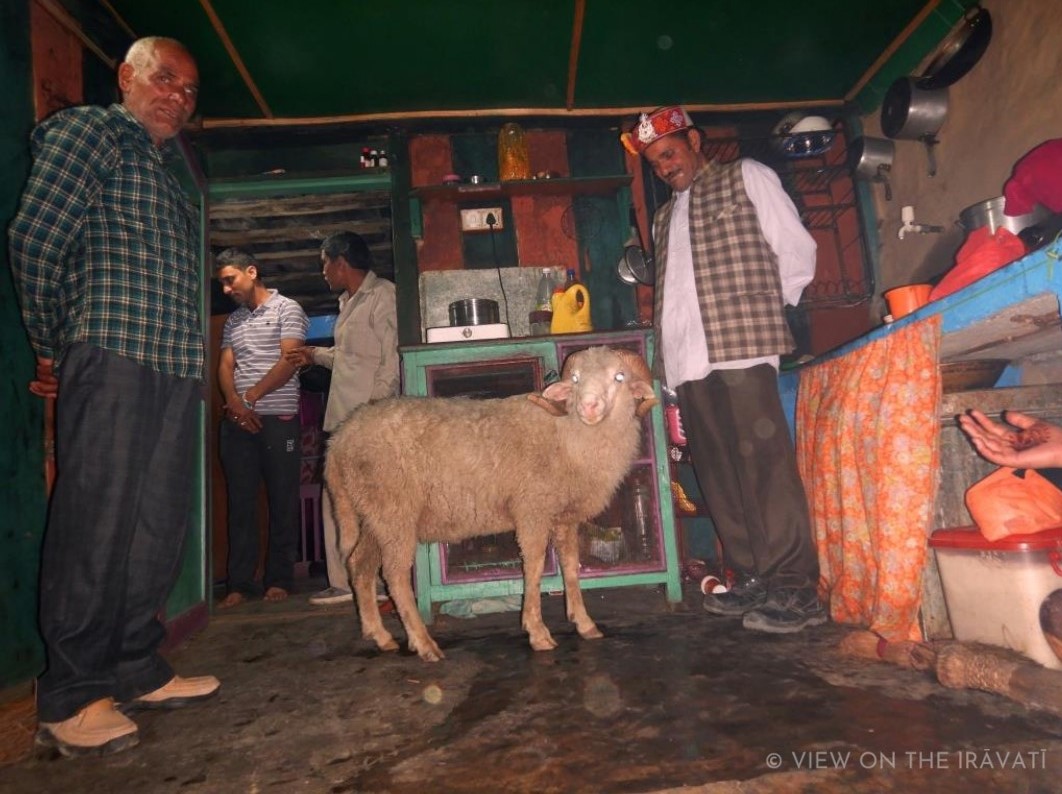
Of course not all animals “consent” to being ritually slaughtered; in this case the sheep pictured above refuse to shake, thus was spared – for now.
Finally the bride . . .
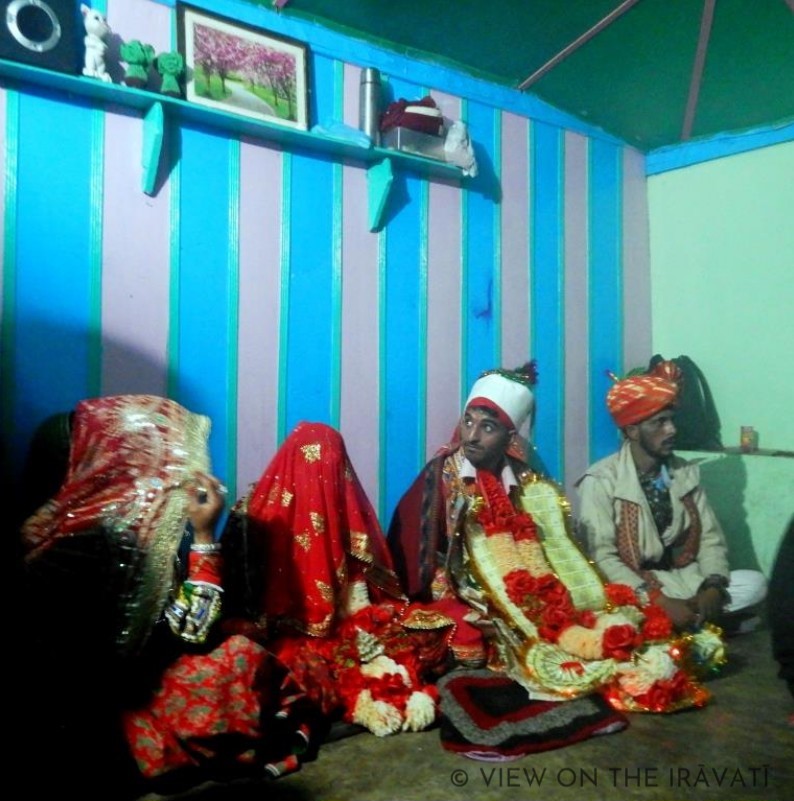
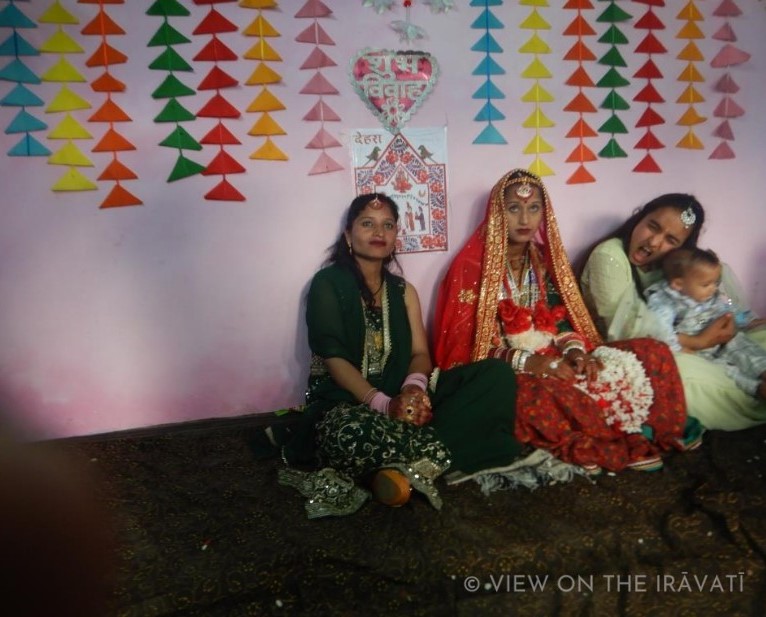
At long last, the bride and groom have arrived at māmā’s house. While we still can’t see the bride’s face, there she is, covered in red, sitting in the family’s temple room. In Gaddī wedding photo albums, pictures of the bride and groom in a few canonical poses adorn the cover and opening pages. Aside from these glamor shots, one rarely sees the bride’s face in the remainder of the wedding photos.
The aesthetics of these photo albums, including my own with it’s outrageous editing, initially didn’t appeal to me beyond being a curiosity. The vast majority of pictures are of the groom’s preparation and gift giving. An entire spread will essentially be one shot, with the groom in the same pose, accompanied in each frame by a different relative by his side, rubbing haldī, pouring oil on his head, or giving a gift.
Once when I accepted an invitation to chai at a distant relative’s house, the bahū broke out her wedding album from 20 years ago. The production style was dated, but all the recognizable poses and set pieces were there. As we flipped through the hundreds of photos, hardly a page went by where the elderly khākho didn’t point to someone and lament how they have since passed away.
These comments were unintentionally protreptic. My attention turned to the fact that for many older relatives, a photo or two from an album like this might be the only picture of them ever taken. The only physical reminder of their likeness to be cherished.
The relations memorialized in Gaddī wedding albums also point to the centrality, or near-sacredness, of the wide web of familial bonds in Gaddī culture. While the joining of the bride and groom provides the occasion for the wedding, the whole affair is predominantly a celebration and reinforcement of family ties.
There is no Kids’ Table
Well, there aren’t any tables at all since all eating and chai drinking is done while seated on the ground.
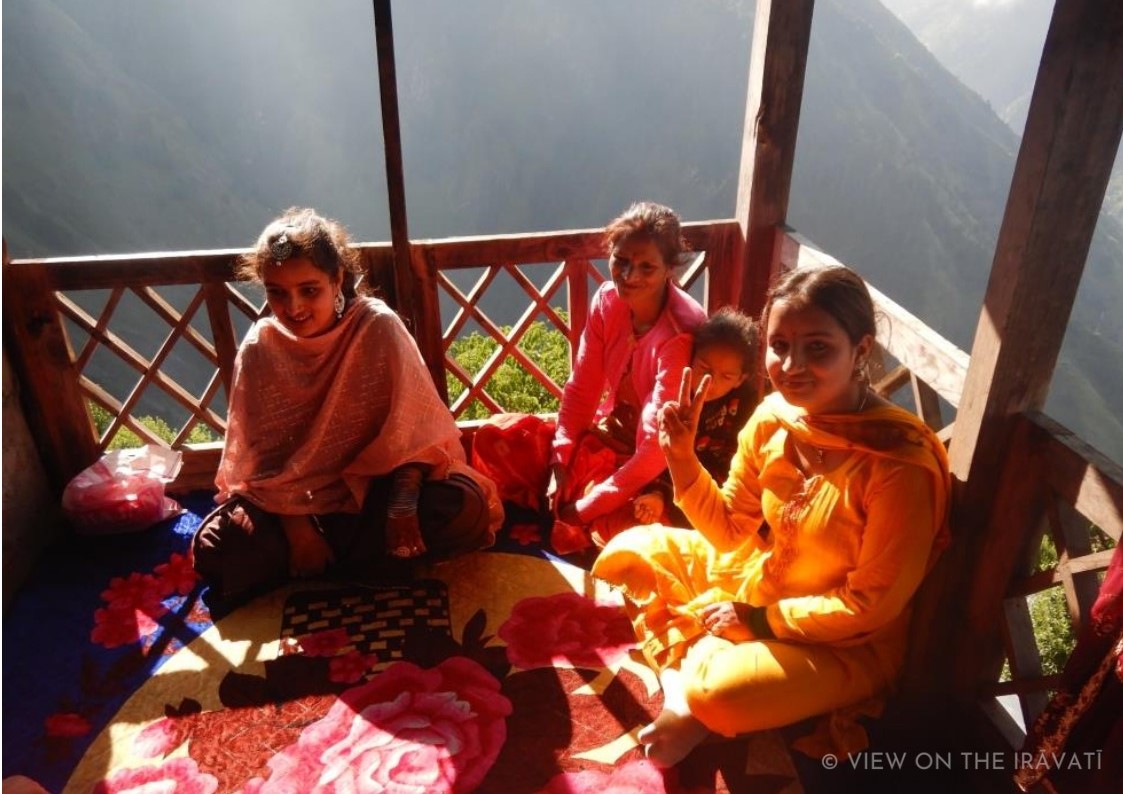
When I tell people that my husband and I have been married for four years, and they note the absence of children, they either become uneasy or insistent that the duty should be done soon – ek munda hona chaiye – “you need to have a son.”
A repercussion of this attitude is the ubiquity of children in Gaddī society; few places more visibly so than in a wedding. Temporarily liberated from school, they rush to meet distant cousins and form roving gangs that weave between women and men talking on balconies and dancing in the courtyard.
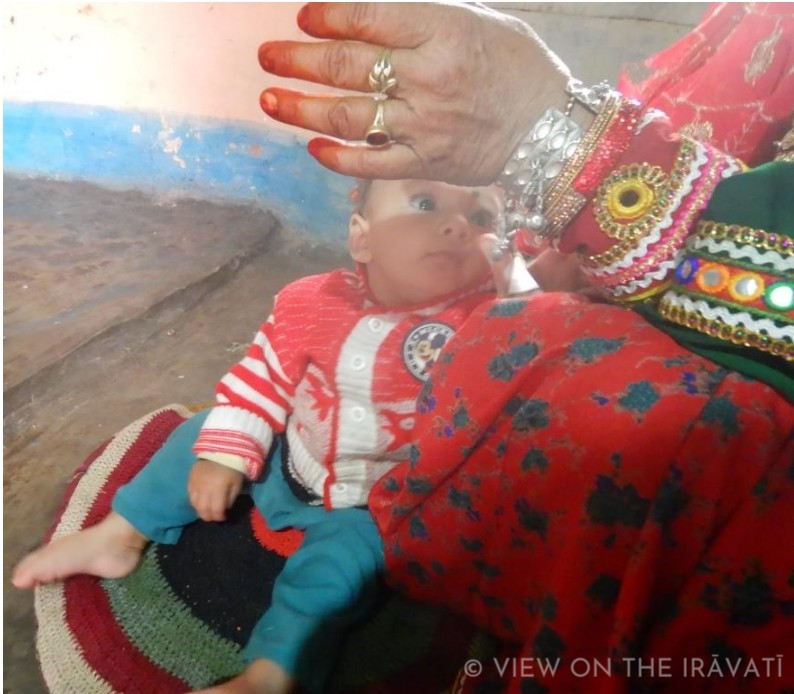
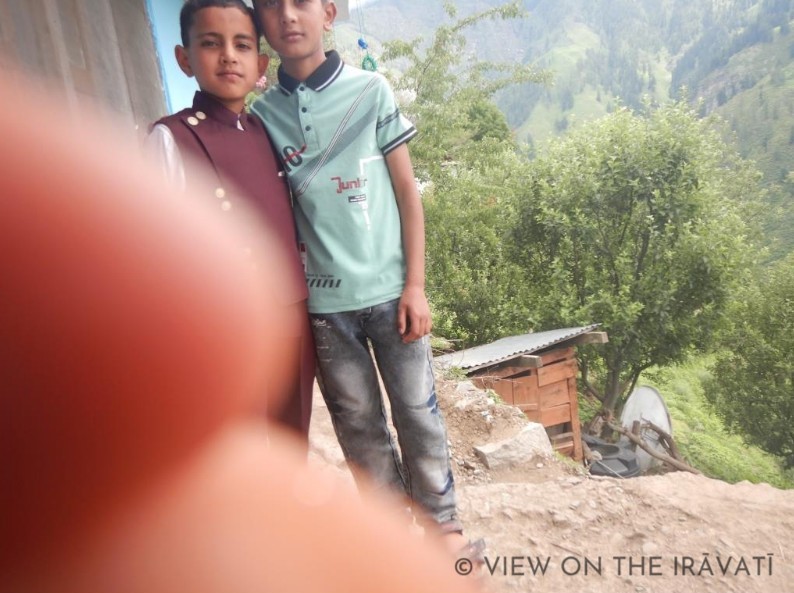
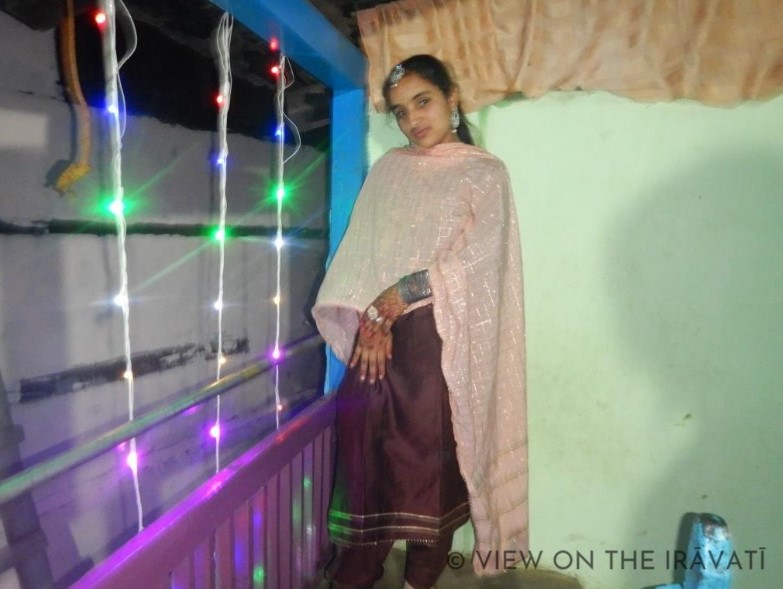
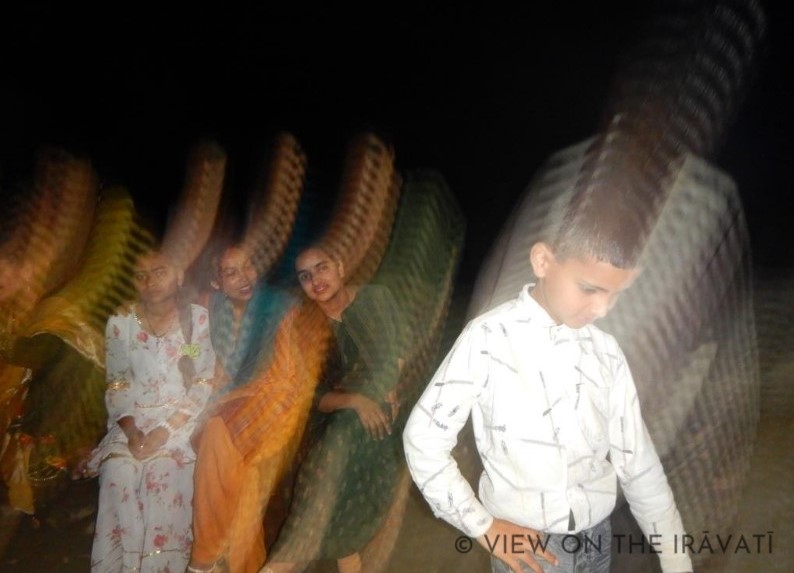
Nowadays, most children have access to a parent’s or relative’s mobile and are used to taking pictures, each having a curated set of selfie faces. Still, our small, yellow Nikon sticks out as a dedicated camera and many kids come pleading to try it out – some of the results are entertaining and others reach for the heights of fine art.
Being a shepherding people, there are also kids of another kind present. Desperate to shift gear from sitting and forcing conversation in my pitiable Hindī, I went with another woman to bring food from the wedding feast to a hired shepherd. This longtime companion of māmā named Kernelu (derived from “Colonel”) was watching over the flock in a pasture behind the village.
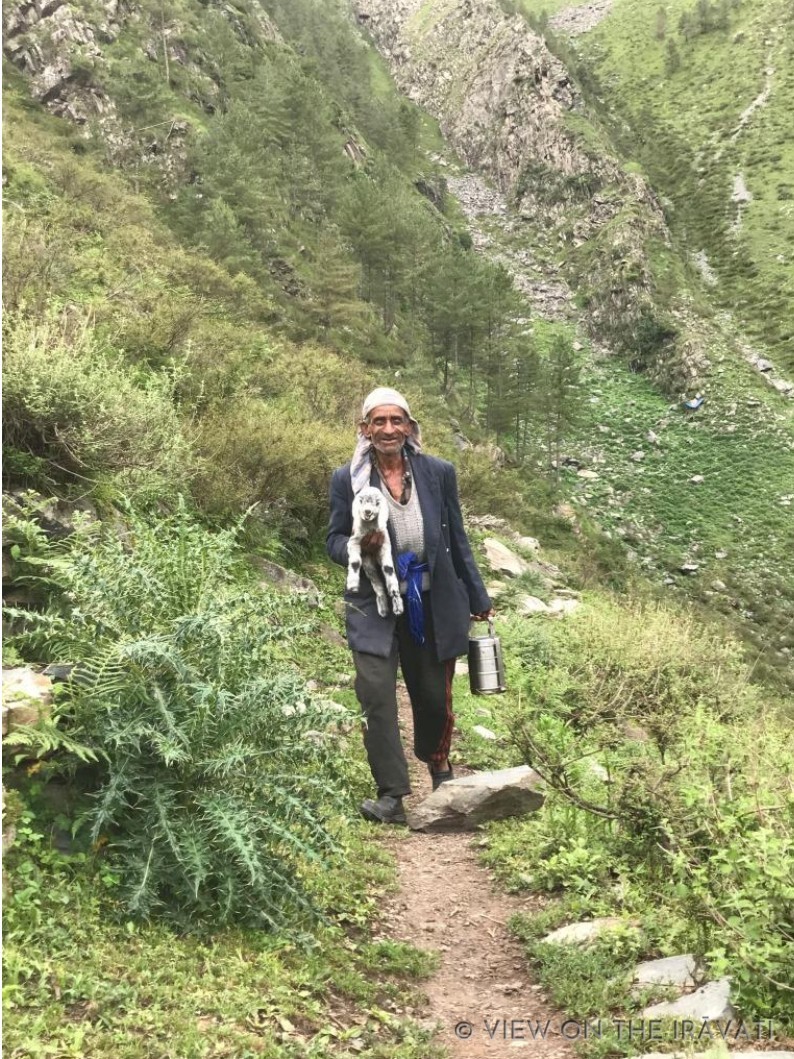
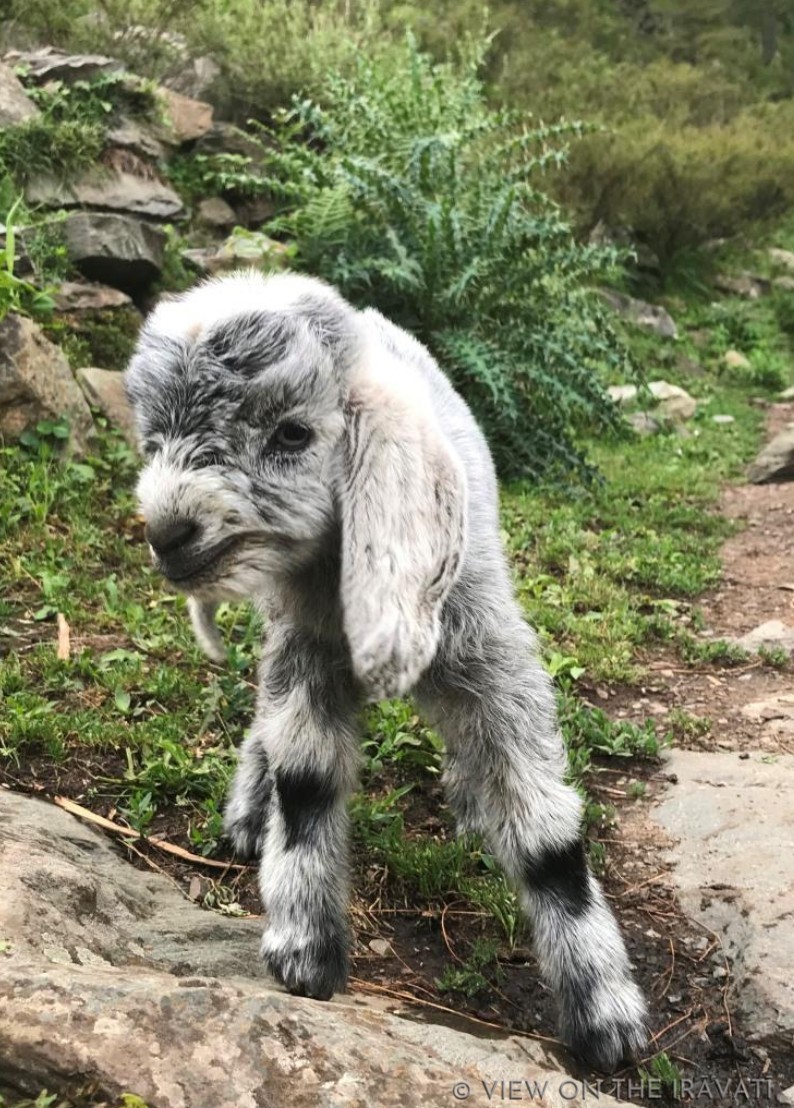
Upon seeing me and remembering a prior visit during which I was rightfully obsessed with all of the baby goats, he walked off and returned with this goat sporting a glorious grimace.
Happily Ever After
After four days, the ubiquitous, pounding bass has died down and the newlywed couple is nowhere to be seen; similar to their near total absence from this album. They are united, the family has grown a little larger, and the village population slowly goes back to its baseline.
The incompleteness of this take on a Gaddī wedding album is partially due to my sporadic participation, during which time I couldn’t take pictures, and partially due to the structure of the wedding itself. Still, I hope that some of the unique facets of a Gaddī village wedding have shone through this meandering post.
As much as I wish Tanmanā and Lucky well, I went with a special affection for māmā and māmī in my heart. As the last professional shepherds in the family, who have gone through hardships I can’t even fathom, this was an opportunity to celebrate the most important milestone in their parental duties and be there for the good times.
||शुभ लाभ ||
 View on the IRĀVATĪ
Leave a comment