Why add a glossary?
This is a blog about cultural immersion and impressions; along the way I’ve learned new words and cultural concepts that eventually make their way into the posts. Here are a few key Gaddī (G), Hindī (H), and Saṃskṛtam/Sanskrit(S) terms to help make the posts more accessible.
You might notice some markings around the letters, these are diacritical markers to represent phonemes absent, or less defined, in the English language. I’ve decided to compromise between the standardized IAST format and a more intuitive English spelling for people totally unfamiliar with South Asian languages. For example, “श” is “śh”, ष is “ṣh”, and च is “ch”, all with an “h” to help you get a better sense of the pronunciation.
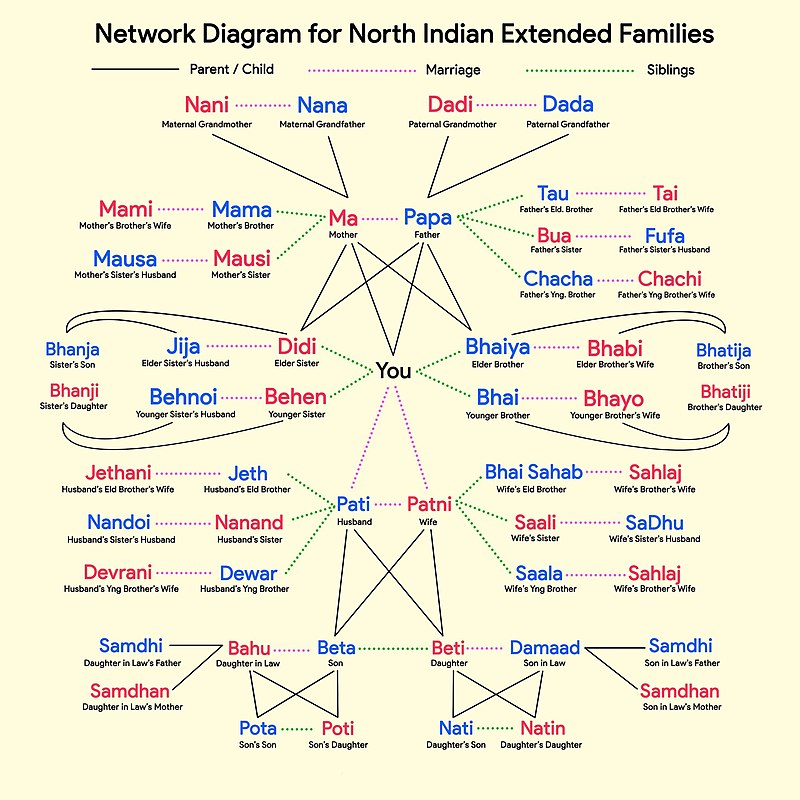
This glossary also contains a few of the highly gendered and hierarchical terms common in describing North Indian family relations. Scroll to the bottom for an extremely helpful network map of these relational names.
What’s that word?
Bhadrapāda/Bhadon
(S/H)
Name of traditional month in the Hindu calendar, which will coincide with August/September in the Gregorian calendar.
Bharmour
(H+G)
This is the name of a town, sub-district (then spelled “Brahmaur”), and general geographical marker for the homeland of the Gaddīs; in this sense it is also called “Gadderan.” The name is said to be a derivation of “Brahmapuram” – “The city of Brahmā.” It was established as the seat of a kingdom by Meru Varman in the 6th Century. There are several striking temples here from the 7th century, including a whole temple complex dedicated to the 84 Siddhas, called the Chaurasī mandir, and a well-preserved wooden temple to Lakṣana Devī, who has a form similar to Mahiṣhāsuramardinī (Durgā). Two nearby pilgrimages include Bharmānī/Brahmāṇī Mātā which is just above town and Maiṇmaheśh Kailāśh, the most esteemed pilgrimage site and local cosmic center accessible via Haḍsar, 12 km away.
Bhattiyāt
(H)
A sub-district in the lowlands of western Chamba which borders Punjab, Jammu, and the Kangrā district of H.P.
Budhil
(G+H)
Name of a river and the valley formed by it, above which Bharmour is situated. It is a tributary of the Rāvī River. “Budhil Valley” and “Bharmour Valley” can be used interchangeably.
chāchā (H+G)
Paternal uncle (younger than father). (See Indian Family Network Map)
chāchī (H+G)
Paternal uncle’s (chāchā’s) wife. (See Indian Family Network Map)
Chambā
(H+G)
A town which serves as the administrative hub of the Chambā district. The whole district has an estimated population of 584,500 (2023) mostly peppered along the steep mountain valleys which comprise the district. There are ten sub-districts (tehsil), the major ones being Chambā, Brahmaur, Dalhousie, Holī, and Pangī. The kingdom established by Meru Varman in the 6th century CE in Bharmour was shifted by his descendant Sahil Varman to Chambā in the early 10th century CE. He named the more temperate city on the banks of the Irāvatī (Rāvī) after his daughter Champāvatī. The word “Champā ” has several etymologies, one of which links it to the beautiful orchid tree (Bauhinia variegate), known as kachnar in Hindī. There are several impressive temples in Chambā, including the Lakṣhmī-Nārāyaṇa complex and a Chamuṇḍā Devī up on a hilltop above the city. At the Bhuri Sing Museum, you can find a surprisingly rich collection detailing the history, crafts, and cultural traditions of the area. Chambā is an underrated destination in Himāchal; there is really a lot to see and experience in the surrounding area.
chelā
(G)
An oracle for distinctive local deities; known as a “gūr” in other parts of Himāchal like Kullū. Almost each village has at least one local chelā. Certain unique or powerful chelās might have some regional notoriety and draw. They are often involved in marriages and other ceremonies, both at home and at temples and pilgrimage sites. Their trance is induced by singing, drumming (ḍholkī), or other kind of music as well as the offering of substances like dhoop (incense), sindhūr, water, and even whiskey. Once the trance is induced, the deity is assumed to be present. Locally this stage is referred to as “devta nachte hain” – the deities dance. At this point people approach the chelā, sometimes with specific questions and other times just to receive the blessing of the deity. Usually the hierophany, or divine appearance, is concluded with a general statement of the satisfaction or dissatisfaction of the deity.
chunnī
(H)
Also called a dupattā in other parts of India. This is the scarf or veil worn by all married woman as a way to cover their face in front of anyone perceived as “higher” than them in the social hierarchy, particularly amongst the men in their husband’s family. It is also a standard part of the wardrobe and can serve as a handy way to protect the face from the elements and as a hand towel when needed. The bright red and tinsel “veil” presented to and word by the mūrti (iconic form) of goddesses is also called “chunnī.”
Dalhousie
A town of about 7,000 people is spread across five hill tops and surrounded by dense coniferous forests. Its the most popular hill station in Chambā, attracting summer tourists escaping the heat as well as winter tourists giddy to see snow. Dalhousie was established by the British in the mid-19th century and there are some old churches here reflecting this colonial period, including one dedicated to St. Francis. Nearby people can also visit Khajjiar and Dainkuṇḍ.
darśhana/darśhan
(S/H)
“vision”, “view”, or “seeing” – used to refer both to the “views” of different systems of thought, in this way translated as “philosophy”, and to the experience of beholding the divine in a temple, often embodied in some form, icon, or marking that stands in for the divine presence itself. It is commonplace to say “I’m going to go have darśhan at ___ mandir.”
deodār/ devadāru
(H/S)
Cedar tree (Cedrus deodara) native to the Himalaya. It’s wood is prized, as all cedar wood is, for building traditional homes and furniture. “deva” means “deity” and “dāru” means “tree” in Sanskrit, making “deodar” literally a “divine tree.” It’s oils and resins naturally repel many insects and are used in the production of various soaps and incense.
Deva & Devatā
(H+S)
God or deity. Many Hindus regard the divine as most essentially one, but many for the purposes of worship and specific outcomes; similar to how some Catholic people pray to a particular saint for safety during travel or healing.
Devī
(H+S)
Goddess, or the feminine form of the supreme divine energy (śakti). Many Hindu deities are worshiped as married couples with deva and devī counterparts: Śhiva and Pārvatī/Kālī, Viṣhṇu and Lakṣhmi, etc.
dharmaśhāla
(H+S)
A place of refuge for devotees or pilgrims
Dharmśhala
(H)
A town in the Kangrā District of H.P. that is home to His Holiness the Dalai Lama and the Tibetan government in exile. A popular place for spiritual tourism where you can learn about Tibetan Buddhism and various kinds of wisdom traditions as well as meditation techniques.
Dhauladhār
(H+G)
Himalayan Mountain Range between the Kangrā , Kullū, and Chambā districts of Himāchal Pradesh. It’s highest peak is called Hanumān Tibba, close to Manālī in Kullū.
dhūpa/dhoop
(S/H)
Incense, but particularly a pliable form that looks and feels like a dark Tootsie Roll. It was traditionally made of aromatic herbs, roots, and oils mixed with binders and natural fillers like charcoal, sawdust, cow dung, and ghee or coconut oil. Modern, cheap, and widely available varieties are made with petro-chemical derived binders and artificial scents which are harmful to health when burned. Still, offering dhoop hand-rolled into little cones forms the backbone of most daily rituals performed by Himāchalī Hindus in their homes and temples.
Durgā
(S+H)
Hindu Goddess – “She who is unassailable”; she embodies the motherly as well as martial. One of her most glorious forms is Mahiṣhāsura-mardinī, the ten-armed slayer of the buffalo demon representing ignorance. During the autumn festival of Navarātri her nine forms are worshiped in many parts of India and most enthusiastically in West Bengal.
Gaddī
(G+H)
The Gaddīs are a pastoral tribal community with their own language, also called Gaddī, native to Chambā, specifically Bharmour. Their traditional livelihood was working as shepherds moving with large flocks of sheep and goats between summer and winter pastures. They are only semi-nomadic, or transhumance, meaning they have fixed homes and fields that they till, but they move for the sake of their flocks throughout the year. There are about 180,000 (c. 2011) Gaddīs in H.P. They increasingly look for government or private sector jobs, rather than pursue the arduous livelihood of their forefathers walking hundreds of kilometers and traversing high mountain passes. Their roots are mysterious, with some possible ties to Rajasthan, but it is generally agreed that they shifted here after some generations of nomadic herding in the plains . They can be generally described as Hindu and their worship centers on Śhiva and Kālī, as well as a host of local deities.
Gujjar
(H)
Gujjars are a predominantly Muslim pastoral tribe that can be found in several South Asian countries, including India, Pakistan, and Afghanistan. They are a numerically larger community than the Gaddīs overall, though less of them roam through Himāchal. They mostly herd buffalo, but sometimes they’ll keep a few cows and goats as well. They are also more strictly nomadic, moving across the Pir Panjal and other ranges, setting up temporary camps in the jungle and on the edges of villages.
Haḍsar
(G+H)
A village 12 km deeper into the Budhil Valley from Bharmour. Here there’s a large gate marking the official starting point for the 13 km trek to Maṇimaheśh Kailāśh. Harḍsar is where many Gaddī pujārīs live, while they spend about a month or so receiving pilgrims and providing amenities up near the lake during the main pilgrimage season during August/September.
Himāchal Pradeśh
(H)
Abbreviated H.P., it is one of India’s 28 states located almost entirely in the Himalayas bordering Jammu, Kashmir, Uttarakhand, and Punjab. Many parts of Himāchal have been under the administrative and cultural influence of neighboring Punjab following India’s Independence and it was only established as a separate state in 1971. There are 12 districts in H.P., including Chambā. Many people flock here in the summer, taking refuge from the heat across the planes. The most popular districts for tourists are Śhimlā, Kullū, and Kangrā .
Holī
(H+G)
Not to be confused with the Hindu festival, this Holī refers to a town, sub-district, and valley located in the Dhauladhār range between the Bharmour Valley and Kangrā . Like Bharmour, it also has a higher percentage of Gaddī villages than other parts of Chambā.
jātar
(G+H)
“Pilgrimage”; coming from the Sanskrit “yātra.” It literally means the act or motion of going to a holy place. There are many prominent temples, peaks, and holy lakes in Chambā; Maṇimaheśh being the most prominent one.
jyeṭh
(H+G)
Coming from the Sanskrit “jyeṣṭha” it literally means “oldest” or “first”. So if something is bigger or first in a sequence, then it will be called “jyeṭh,” such as the oldest son in a family or the first Monday of the lunar month.
Kālī
(S+H+G)
Kālī’s name is derived from the Sanskrit word for time, as well as black, “kāla.” She is a famously fierce from of the divine feminine, often depicted holding a severed head and a large sword (khaḍga), standing over a prostrate Śhiva, with whom she is sometimes paired. Kālī, or one of her forms, is the primary manifestation of Devī worshiped by Gaddīs.
Kangrā
(H)
Name of a town, district, and valley in Himāchal bordered by one side by the Dhauladhar Mountains and by low lying hills leading into the plains on the other. This is where Dharamshala is located and where many Gaddīs traditionally went for winter pastures; some even settled here in villages like Bhagsu, near Dharmśhala.
Khundī Mātā
(G)
A place of pilgrimage named for a goddess presiding over a lake and mountain in the Churah Valley, another sub-district of Chambā. “Mātā” is commonly added to the names of goddesses and means “mother.”
Kugtī
(G)
A wonderfully rustic village at the very end of the Budhil Valley and at the beginning of a trek over the Kugtī Pass into Lahaul. It is also located on the periphery of a wildlife sanctuary where researchers come to study Himalayan bears and other animals.
kuladevatā/kuldevtā
(S+H)
Literally “deity of the family” – a deity worshiped for many generations offering protection and guidance for a particular family. Some families have just one deva (god) or devī (goddess) that they worship, others have both a kul-deva and a kul-devī. Most of the time this is a specific deity of place, a particular mountain peak or waterfall, and it won’t directly be one of the major Hindu Gods, like Śhiva, but regarded as a manifestation of or in some way connected with a major god or goddess.
Lahaul
(H)
Lahaul and Spittī is another district in Himāchal entirely located in the middle to upper Himlāyas and possessing a much more rugged appearance than other parts of the state.
langar
(Punjabī + H)
This is a Punjabi word, borrowed from Persian. Originally it was a Sufi tradition of givng out cooked food to whoever would take it. It has been adopted in Pahadi/Gaddi to mean something similar, a community cook out where all are welcome to come and eat free of charge.
liṅga
(S+H)
Literally meaning “mark” , a Śhiva liṅga is an aniconic form that centers the worship of Śhiva. Sometimes it is crafted from stone, crystal, or metals; other times a natural outcrop or whole mountain can be revered as a Śhiva liṅga.
maggi
For Americans: read “Top Ramen”
māmā
(H+G)
Maternal uncle (see Indian Family Network Map)
māmī
(H+G)
Maternal uncle’s wife (see Indian Family Network Map)
mandir/mandiram
(H+S)
Temple; can apply a large and ornate structure or a small shrine
Maṇimaheśh
(S+H+G)
Literally “Great lord of the jewel”, this is the name of a mountain in the Dhauladhar range and the highest peak in the Bharmour area. It’s highly revered as a Kailāśh/Kailāsa, a local variation on the sacred mountainous abode of Śhiva and his divine retinue. The more famous Kailāsa, also known as Mt. Meru, is located in Tibet and worshiped by Hindus, Buddhists, and Jains. The main yātra/jātar to Maṇimaheśh Kailās happens in the Hindu month of Bhādrapada, between Janmaṣṭhamī and Rādhāṣṭhamī, usually around August or September in the Gregorian calendar. It is during this time that the sunrise when viewed from a nearby alpine lake seems to appear just at the peak, resembling a jewel (maṇi). Many Gaddīs pay their obeisance to Maṇimaheśha once the peak is visible as you enter the Bharmour Valley and some who live in view of the mountain peak perform a daily ritual to the towering presence of Śhiva.
Māralī
(G)
A local manifestation of the great goddess (mahādevī, śhakti) worshiped by many Gaddīs. She is occasionally identified with Kālī. Her main shrine is 6 kilometers behind the village Kugti, next to a temple dedicated to Kelang Svāmī, a version of Skanda/Kārttikeya, the martial god and mythical son of Śhiva. Some people regard Māralī and Kelang as sister and brother.
mausī
(H+G)
Maternal aunt related by blood, as opposed to a māmī who is a maternal aunt related by marriage. (See Indian Family Network Map)
mūrti
(S+H)
Iconic form of a deity which is worshiped with offerings such as water, flowers, incense, sweets, etc. Mūrtis are regarded as a direct divine manifestations. Many Hindu practitioners are quick to clarify that they don’t worship idols. For most it is a chance to be with the supreme, or be reminded of the supreme, through a tangible form, as an admission of our human limitations when approaching the divine.
(S+H)
Literally “nine nights” this nine-night festival is dedicated to Devī/Durgā in her many cosmic incarnations. The main Navarātri happens in September or October and is called “Śhāradā Navarātri,” though there are actually four cycles of nine-nights dedicated to the Great Goddess throughout the year. Each night has a particular form of the Goddess who is worshipped, for example the first night is dedicated to the meditation upon Śhailaputrī, “the daughter of the mountains,” another name for Pārvatī. Navarātri is celebrated with great relish in West Bengal, where it is also called Durgā Pūjā. Some Goddess temples in Himāchal will have a special programs with singing and special food preparations for the whole period or at least the last night.
parikrama
(S+H)
Circumambulation; In Hinduism and other religions of Indian origin, reverance and connection to a sacred site, icon, temple, or even an entire mountain is shown by walking in one or more circles around it. Usually the deity or divinely charged site is kept to one’s right, so one walks to one’s left to begin walking around it.
Pārvatī
(S+H)
“The daughter of the mountain” – a Goddess and traditional consort of Śhiva as recognized by widely practiced forms of Hinduism. Whereas Māralī and Kāli often have independent shrines, Parvatī is most often evoked and worshiped together with Śhiva.
Pir Panjal
(H)
This is a mountain range in the Western Indian Himalayas that runs roughly east to west, north of the Dhauladhar Range. Even though it contains some peaks, like Deo Tibba, which are over 6,000 m tall, it is considered part of the lower Himalayas and stretches across Himāchal as well as Jammu & Kashmir. Much of Chambā comprises valleys and peaks belonging to this range.
poha
(H)
Delicious, light, and easy to make savory dish prepared from parboiled and squashed rice, basically rice flakes. Often prepared with curry leaves, mustard seeds, peas, peanuts, turmeric and finished with fresh coriander leaves (cilantro), since the rice is already cooked and just needs to be re-hydrated by soaking prior to cooking for a minute or two with the taḍka , or tempering, of spices fried in ghee or oil.
pujārī
(H)
Hindu Priest. In Hinduism, priesthood is largely an inherited livelihood traditionally ascribed to males of the Brahmin caste, though certain devotional and tribal sects might have women or people of other castes serving as pujārīs. At temples and sites of pilgrimage they maintain the sacred space and perform small rituals for devotees, in return for which people donate gifts or a sum of their choosing. Other pujārīs have memorized long sections of the Vedas and other texts; they might perform wedding ceremonies or rituals on behalf of a patron for a desired aim. Aside from waxing philosophical and sharing local mythic-historical tidbits with curious people, Hindu priests don’t preach or attend to congregations. They are there to facilitate the religious actions and perform sacraments for the rest of the Hindu population.
rajma
(H)
Kidney beans. A staple of Gaddīs and Chambā dwellers in general; it grows well in the region. A particularly decadent preparation called madrā involves slow cooking rajma with curd, ghee, and warming spices like cinnamon and black pepper.
Śhakti
(S+H)
Literally meaning “power, potency, or energy”, in some Hindu texts this is the name given to the great, universal power of God (Śhiva) and is hypostatized as a Goddess and his consort. Sometimes she is even worshiped separately from her association with Śiva and exalted as greater than Śhiva. In Chambā there is a unique and magnificent iconic form of Śhakti Devī in the village of Chhatrārī.
siddha(s)
(S+H)
Literally “the accomplished (ones)” in Sanskrit; both Hindu and Buddhist Tantric traditions mention these “perfected” beings, who were in some cases actual historical practitioners and in others are more primordial or mythical in nature. They are typically regarded as highly skilled in yoga, meditation, and various spiritual techniques which often manifest as supernatural powers and knowledge. Sometimes they are grouped into specific sets, like “the 84 siddhas”. The Chaurasī complex in Bharmour literally means “84” in Hindī and is connected to the group of 84 Siddhas.
sindhūr
(H)
Śhiva/Shiv
(S+H)
Bright orange powder used in Hindu rituals. It was originally derived from tawny rocks found in the Sindh region, hence the name.
Major Hindu God, also called Mahādeva, “the Great God”, whose worship takes many forms across India. He is said to live in the Himālayas, so he is particularly dear to most people in Himāchal Pradeśh and has many devotees here. He is regarded as a supreme and ultimately benevolent deity that also has fierce and destructive forms. The triśūl (trident), a liṅga (“sign”, usually stone) and a bull called Nandī (his “vehicle”) are the symbols most commonly associated with him.
tehsil
(H)
Sub-district for administrative purposes.
Tissa/Tīsā
(H)
transhumance
Town in the Churah Valley, also sometimes called the Tissa Valley, in the northwestern part of the Chambā District.
Pattern of pastoral living with a shift between summer and winter pastures along well-worn traditional migratory routes. This is a semi-nomadic way of life found all over the world, for example in the Alps, and the Gaddī are considered a textbook example of a transhumance culture. In contrast to purely nomadic peoples, a transhumance tribe or ethnicity might have a permanent home that they spend part of the year in, or where some women, the elderly, and small children live year-round.
triśūla/trishool
(S+H)
Trident. More commonly associated with Śhiva all over India, in this part of Himāchal it is also a sign of the Goddess. Near temples and other holy sites dedicated to the Goddess, it’s common to see large collections of iron and brass tridents that have been brought and offered by pilgrims. For people not familiar with the Indian cultural-religious context, the triśūl, like the svastika, can be a bit jarring or confusing given the diabolical/evil associations both symbols have in Western cultures. Here in India, both are positive symbols of the divine that have been used for millennia. “Svastika” means “mark of auspiciousness” in Sanskrit and is usually drawn facing the right/clockwise direction whereas the version misappropriated by the Nazis faces the left.
Upaniṣhad
(S+H)
Refers to sacred texts, originally oral teachings, composed beginning around the end of the Vedic period, from 600-700 BCE onward. They are highly revered for their wisdom, poetic, and often touch on philosophical themes. Many focus on explanations of symbols and meaning in ritual, as well as in the natural world. They have been variously canonized, with groups of 10, 11, 12, and up to 108 Upaniṣhads; though the primary grouping of 10 which includes the Bṛhadāraṇyaka, Aitareya, and Katha Upaniṣhads is considered the most ancient. These ancient Upaniṣhads are each connected with a branch of traditional Vedic recitation and learning. Various sages and devotional sects came up with their own Upaniṣhads throughout Indian history, leading to the ever increasing numbers of Upaniṣhads.
Finally, here’s how to find your place within a North Indian family:
 View on the IRĀVATĪ